<?xml version="1.0" encoding="utf-8"?><feed xmlns="http://www.w3.org/2005/Atom" ><generator uri="https://jekyllrb.com/" version="4.4.1">Jekyll</generator><link href="https://erinrwhite.com/feed/by_tag/ux.xml" rel="self" type="application/atom+xml" /><link href="https://erinrwhite.com/" rel="alternate" type="text/html" /><updated>2026-03-05T14:12:20+00:00</updated><id>https://erinrwhite.com/feed/by_tag/ux.xml</id><title type="html">Erin White</title><entry><title type="html">Threats and opportunities for mature design systems</title><link href="https://erinrwhite.com/design-systems-threats" rel="alternate" type="text/html" title="Threats and opportunities for mature design systems" /><published>2025-09-14T00:00:00+00:00</published><updated>2025-09-14T00:00:00+00:00</updated><id>https://erinrwhite.com/design-systems-threats</id><content type="html" xml:base="https://erinrwhite.com/design-systems-threats"><![CDATA[<p>My day job for the past couple of years has been <a href="https://bradfrost.com/blog/post/a-design-system-governance-process/">design governance</a> for a very large website. Put simply, my team helps keep this giant website consistent and accessible for our millions of users.</p>

<p>Our digital ecosystem is big, and there are scores of teams using our design system to build their products (<a href="https://www.nngroup.com/articles/design-systems-101/">What is a design system?</a>). Our design system has been around a while, it’s super-robust, and it has buy-in across the organization. My team’s main job is to meet with other teams throughout their design process to make sure that the teams’ products align with the rest of the website, meet web and accessibility standards, and of course, use our design system appropriately.</p>

<p>This doesn’t happen all the time, but there are some recurring patterns I’ve observed as product teams work with our design system. I don’t think this is unique to our context; I’d wager that these are totally normal things that happen when a design system matures and is in active use by a lot of teams.</p>
<h2 id="1-design-by-number">1. Design by number</h2>
<h3 id="what-it-is">What it is</h3>
<p>Instead of designing an experience or an interaction, the team puts design system components on a page (or in a Figma file) to create an interface, without thinking about the actual user experience. Components are chosen because of how they look, not because of what they do. It’s not UX so much as paint by number. The design has features you recognize, but that’s where the familiarity ends.</p>
<h3 id="why-it-happens">Why it happens</h3>
<ul>
  <li><strong>Inexperienced designers</strong>: Designers who take this approach are often new or inexperienced, undersupported, or stretched too thin.</li>
  <li><strong>Free-ranging stakeholders:</strong> A non-designer stakeholder is exerting undue influence on the design, or is being inflexible about business rules, and designers are not empowered or knowledgeable enough to push back. Common signals that a stakeholder is pulling the strings:
    <ul>
      <li>”We’ll need to get approval for that change.”</li>
      <li>“Our stakeholder said we need to do it this way.”</li>
    </ul>
  </li>
</ul>

<h3 id="the-result">The result</h3>
<p>If you have a pre-launch QA process for products (as we do), those design issues, if not caught early, result in a ton of problems that need to be fixed before the product goes live. If those findings aren’t deemed important enough to fix before go-live, they go to the team’s backlog to die, and the user experience suffers.</p>

<p>If the product ships as-is, it looks like the rest of your site in some ways, but it’s unusable, inaccessible (or 508-compliant only, rather than truly accessible) and you’re not sure what it’s supposed to do. It doesn’t actually help your users.</p>
<h3 id="interventions">Interventions</h3>
<ul>
  <li><strong>Designers: Focus on clearly defining the problem to be solved</strong>, creating user flows before moving to the toolbox of high-fidelity tools.</li>
  <li><strong>Designers: Design for mobile first</strong> Designing for a small screen (or high browser zoom) streamlines design and really forces decision-making about the most important elements and interactions. If the page was laid out in one long line, what should the sequence of elements be? What headings would need to be present to help convey the content grouping and hierarchy? This results in a more accessible experience for most users, especially users who rely on assistive technologies like screen readers.</li>
  <li><strong>Leaders: Mentor junior teams and designers.</strong> This problem is not specifically a design system problem, but it’s exacerbated by a readily available component library. It’s moreso an underdeveloped design ethos. Seasoned, user-centered UX designers who are trusted, mentored, and supported to do good work will know and do better. These folks not only have more experience, but are also prepared to push back when stakeholders ask for something that’s a bad solution. Junior designers can grow into this skillset if they have good mentors.</li>
</ul>

<h2 id="2-first-solution-inertia">2. First-solution inertia</h2>
<h3 id="what-it-is-1">What it is</h3>
<p>Because robust design systems and Figma libraries make it easier to rapidly develop high-fidelity prototypes, a team’s early design ideas can sometimes ossify too fast. At first glance, the solution seems good. On second glance, it’s clear there is something not quite right, and there is an increasing number of boo-boos being covered up. The sunk cost fallacy leads teams to keep as much of what they’ve got as possible, even if what they actually need to do is scrap it and start again.</p>
<h3 id="why-it-happens-1">Why it happens</h3>
<ul>
  <li><strong>Jumps to solutioning:</strong> The design problem hasn’t been completely defined. Key information, constraints or business rules are missing.</li>
  <li><strong>Favoritism:</strong> Someone (maybe a non-designer stakeholder?) has fallen in love with an early solution and doesn’t want to change course.</li>
  <li><strong>Iteration creep:</strong> The design started as one thing, but has iterated so much that its functionality has left the bounds of its original design completely and no longer makes sense.</li>
  <li><strong>Hotfix glue gun:</strong> The design doesn’t accommodate unanticipated stress cases, or doesn’t do well in user testing. “Adjustments” are made by adding on hotfixes rather than addressing the root issue.</li>
  <li><strong>Looming deadlines:</strong> a team is far down the road with a high-fidelity design and it’s hard to stop, or to incorporate late-breaking changes, before they have a deadline to complete their work.</li>
</ul>

<h3 id="the-result-1">The result</h3>
<p>The result is something that just ain’t quite right, an incomplete or overly complex solution that has gaps for some users with “non-standard” use cases. It’s an increasingly brittle interface that makes maintenance a bottomless pit until it can be rebuilt. This’ll create frustrating experiences for users, and it’ll be an interface that they have to learn over and over again.</p>
<h3 id="interventions-1">Interventions</h3>
<ul>
  <li><strong>Designers: Go lo-fi first, even when hi-fi is easy:</strong> Build lower-fidelity artifacts early in the process, even when it’s easier to jump straight into the weeds with design software. Focus on user flows, rather than getting every single detail right in the wireframes.</li>
  <li><strong>Designers: Research early:</strong> Do research with users before letting the design harden.</li>
  <li><strong>Designers: Engage peer reviewers:</strong> Get another set of heuristic eyes on your designs. (Either through a governance process or via peer feedback.) Bring your questions.</li>
  <li><strong>Leadership: Build in slack time:</strong> Account for time in the project to make potentially breaking changes. Ensure the team is consistently revisiting those user flows from earlier in your design process to make sure you’re solving the right problems the right way.</li>
</ul>

<h2 id="3-disengagement">3. Disengagement</h2>
<h3 id="what-it-is-2">What it is</h3>
<p>Teams use the design system to design experiences (perhaps quite well!) but don’t contribute to the design system’s growth. Or, they may craft workarounds when the design system doesn’t do things <em>exactly</em> as needed, rather than suggesting changes.</p>
<h3 id="why-it-happens-2">Why it happens</h3>
<ul>
  <li><strong>Lack of support from leadership:</strong> Teams aren’t incentivized, encouraged, or given space to contribute back to the design system and allow it to continue to grow, so it stagnates.</li>
  <li><strong>Technical debt</strong>: Teams don’t have time to contribute to the design system because their backlog is too big, they’re moving too fast, or they are simply prioritizing other work.</li>
  <li><strong>Gatekeeping:</strong> The process for contributing to the design system is opaque, or onerous, or locked down to only one team (or person!). If community members feel like they can’t or shouldn’t contribute to the design system, they don’t.</li>
  <li><strong>Inflexible/rigid design system:</strong> The design system isn’t helping the teams solve their problems, or is incomplete. Or, the team’s engagement with the design system is more punitive (“Fix this or else”) than generative (“Let’s make sure this component does what you need it to do”). Rather than being seen as a toolbox, it’s a checkbox.</li>
</ul>

<h3 id="the-result-2">The result</h3>
<p>The implications for this are system-wide. The overall user experience of your digital ecosystem can suffer. Stale, inflexible experiences don’t evolve with the times, or worse, teams abandon design system components to craft their own experiences, creating long-term maintainability problems. The end result is a degraded experience for your users, a maintainability quagmire, and inconsistent designs across your platform. In my work context, this is something we work very hard to avoid.</p>
<h3 id="interventions-2">Interventions</h3>
<ul>
  <li><strong>Leadership: Prioritize contributions:</strong> Product owners/product managers build time in for their teams to contribute to the design system, and actively encourage them to do so.</li>
  <li><strong>Design system leads: Make contributions a snap:</strong> Design system owners should pave avenues for teams to make or suggest updates to the design system. The process for new additions to the design system, code updates or new documentation should be well-documented, communicated, and streamlined, including (and especially) for newcomers or novice coders.</li>
  <li><strong>Governance and design system leads: Listen and adapt</strong>: Inflexible, brittle design systems with overly complicated processes, obtuse approval processes, or hard-to-use tech stacks are expensive to maintain because they are brittle. It’s crucial to have clear processes for using, expanding on, updating, or even retiring items from the design system. Humans who are responsible for the design system want product designers to use the system in a consistent way; but conversely, they must be listening for ways the design system can flex to meet changing needs.</li>
</ul>

<h2 id="tldr-design-systems-are-people">tl;dr: Design systems are people</h2>
<p>Technology is people. Design systems are people, too. Most of the issues here, and their solutions, involve deeply human stuff like relationship-building, conversation, clear documentation, conflict resolution, and feedback loops.</p>

<p>Like any other technology, design systems need attentive care, maintenance, upgrades, and human stewards to ensure that they’re used to do the thing they’re supposed to do. The key is being prepared to support the entire design system, including the people who are building with it.</p>]]></content><author><name></name></author><category term="ux" /><category term="tech" /><category term="a11y" /><category term="civic-tech" /><summary type="html"><![CDATA[A big part of my day job is making sure that teams use our website's design system appropriately. Here are some traps I see and ideas for how to help the design system and the humans who use it thrive.]]></summary></entry><entry><title type="html">Trans-inclusive design for the Prosocial Design Network</title><link href="https://erinrwhite.com/trans-inclusive-design-prosocial" rel="alternate" type="text/html" title="Trans-inclusive design for the Prosocial Design Network" /><published>2025-05-13T00:00:00+00:00</published><updated>2025-05-13T00:00:00+00:00</updated><id>https://erinrwhite.com/prosocial</id><content type="html" xml:base="https://erinrwhite.com/trans-inclusive-design-prosocial"><![CDATA[<p>The kind folks at the <a href="https://www.prosocialdesign.org/">Prosocial Design Network</a> asked me to be a guest for April’s “pro-social,” a very low-key virtual gathering for folks interested in creating more inclusive digital spaces.</p>

<p>More about PDN:</p>

<blockquote>
  <p>The Prosocial Design Network connects research to practice toward a world in which online spaces are healthy, productive, respect human dignity, and improve society.</p>
</blockquote>

<p>Here’s their <a href="https://www.prosocialdesign.org/blog/pro-social-on-trans-inclusive-design-a-recap">recap of the event</a>, and a <a href="https://www.youtube.com/watch?v=FenzUfbU0Fo">video of our Q&amp;A segment</a> (15 minutes).</p>

<p>They shared the questions in advance, which I very much appreciated! Here are my prepared notes - we certainly didn’t cover it all during the call.</p>

<h2 id="what-principles-should-be-front-of-mind-in-designing-inclusive-digital-spaces-particularly-social-spaces">What principles should be front of mind in designing inclusive digital spaces, particularly social spaces?</h2>

<p><strong>First off, hire people with different lived experiences from yours.</strong> Hire trans people. Hire Black people. Hire disabled people. Hire disabled Black trans people. Let them cook. Listen to them. Otherwise you are, as my wife says, “Pissing into the wind.”</p>

<p><strong>Prioritize accessibility.</strong> Ensure spaces are accessible for users on many devices, using different device settings, in different contexts in the real world including with assistive technologies. Often accessibility is an afterthought. Shift left and allow it go drive your design and architecture decisions from the jump. For social apps, this includes setting smart defaults - i.e. requiring folks to add alt text if they’re uploading images.</p>

<p><strong>Keep your tech stack light and boring.</strong> Design for a 4-year-old Android phone on a 3g connection, with bandwidth paid for by the megabyte. Bloatware takes longer to load and harms or disincentivizes participation from folks on slower connections or older tech.</p>

<p><strong>Design for trust, privacy and safety.</strong> Design for people to be able to protect their privacy, control what they share and what they see.</p>
<ul>
  <li>Don’t ask for information you don’t need, and tell people why you’re asking for what you do need.</li>
  <li>Make privacy and sharing settings crystal clear.</li>
  <li>Remind folks that no site is 100% secure even if you’re encrypting every bit.</li>
  <li>Provide feedback/reporting mechanisms.</li>
  <li>Allow people to block/opt out of interacting with others or groups, or types of content.</li>
  <li>Don’t overpromise! If you have gaps or areas still under development, name them.</li>
  <li>Have good documentation and support. Don’t leave people wondering what to do.</li>
  <li>Look to successful, intentionally-designed communities - like <a href="https://blog.rudyfraser.com/an-internet-of-many-autonomous-communities/">BlackSky</a> - for cues about designing inclusive, safe spaces.</li>
</ul>

<p><strong>Allow people to define themselves.</strong> The way you do it ain’t the way everybody else does it.</p>
<ul>
  <li>Be aware of <strong>any</strong> type of binary options when it comes to identifying themselves - not just gender, but everything else. Are you technical or nontechnical? Employed or unemployed? Full-time or part-time? In all of these cases it’s not so clear.</li>
  <li>Think in terms of checkboxes, not radios. Tagging, not categorizing.</li>
  <li>Give people freedom in choosing avatars or profile images.</li>
  <li>Give people freedom to change/update usernames and login email addresses without hassle.</li>
  <li>Don’t make inferences about who people are or what they’d like based on their gender, race or other things that they choose to share with you.</li>
  <li>Confront your own ideas about people having one “true identity” - like a real name policy or assuming that everyone has the same interactions with everyone in their lives in every context. We certainly know this is true because 4chan exist(ed) - but let’s also remember that this might be the way that a trans person tries on a new name for the first time.</li>
</ul>

<p>You may have noticed this isn’t necessarily specific to trans-inclusive design. That’s because this is the kind of work that, by considering folks in marginalized positions, benefits everyone. It’s the curb cut effect for accessibility AND privacy AND safety AND inclusion. By focusing our design on the margins we include everyone between them too.</p>
<h2 id="since-you-wrote-your-article-in-2019-what-are-fails-sites-continue-to-make-when-it-comes-to-trans-inclusive-design">Since you wrote your article in 2019, what are fails sites continue to make when it comes to trans inclusive design?</h2>

<p>The biggest fail I continue to see is that folks are asking for gender or sex information at all, because it is usually not needed. It usually means that this data is being brokered into a database somewhere and sold for money.</p>

<p>I don’t need to tell you my gender to book a hotel. Why are you asking for it?</p>

<p>The unnecessary asking for gender gets worse now that we are seeing a rollback of  previous progress in inclusive design we had made in the past few years. We’d been doing so well! The US Web Design system <a href="https://web.archive.org/web/20250123072001/https://designsystem.digital.gov/patterns/create-a-user-profile/gender-identity-and-sex/">had a really thoughtful pattern</a> about asking for gender that was starting to roll out to all these government forms. But now agencies are in the process of <strong>removing</strong> the pattern for asking for gender in an inclusive way, and replacing it with a <a href="https://designsystem.digital.gov/patterns/create-a-user-profile/sex/">binary option for sex</a>.</p>

<p>These design systems changes are in addition to removing all references to being trans from websites, and no longer offering services or information for trans people. It’s a very literal erasure of trans identity. It’s really upsetting, scary, and for trans folks, it’s existential.</p>

<p>I encourage practitioners to plan ahead for the moment when you are asked to do something that you know is wrong. That day will come. What will you say? What will you say no to? What’s your red line?</p>
<h2 id="what-new-concerns-do-you-have-with-ai-and-do-you-have-any-advice-for-tech-folk">What new concerns do you have with AI and do you have any advice for tech folk?</h2>

<p>I have a lot of concerns with AI. I do think there are useful applications for the technology, <strong>and</strong> 99.99% of the applications out there are either actively predatory, passively harmful, gratuitous and mid, or all of the above. And they are <strong>all</strong> harming <a href="https://jacobin.com/2024/06/ai-data-center-energy-usage-environment/">the environment</a> and <a href="https://interestingengineering.com/energy/us-ai-data-center-air-pollution">our health</a>.</p>

<ol>
  <li><strong>Garbage in, garbage out.</strong> AI is pattern recognition. And the patterns it’s trained on are filled with bias! Bias harms people who are in the minority. According to a recent study out of Stanford:
    <blockquote>
      <p>“synthetically generated texts from five of the most pervasive LMs …perpetuate harms of <strong>omission, subordination, and stereotyping</strong> for minoritized individuals with intersectional race, gender, and/or sexual orientation identities.” - <a href="https://arxiv.org/abs/2404.07475">Laissez-Faire Harms: Algorithmic Biases in Generative Language Models (2024)</a></p>
    </blockquote>
  </li>
  <li>
    <p><strong>…and this includes code.</strong> When AI is trained on design patterns or code that is widely popular, but that also includes a lot of code that’s inaccessible or unusable, the resulting code is also inaccessible or unusable. We should also be extremely wary of any AI tool that claims it can <a href="https://www.wethebuilders.org/posts/what-it-really-takes-to-migrate-cobol">refactor a codebase</a> written in a language that most modern coders are not using.</p>
  </li>
  <li>
    <p><strong>AI is a tool of capitalism and state violence.</strong> Generative AI is being used to consolidate, analyze, and generate information in a way that can be used to surveil, prosecute, incarcerate, and <a href="https://en.wikipedia.org/wiki/AI-assisted_targeting_in_the_Gaza_Strip">kill people</a>.</p>
  </li>
  <li>
    <p><strong>AI is seen as a smart humanoid.</strong> People tend to <a href="https://www.nature.com/articles/s41598-021-87480-9">believe algorithms more than each other</a> as task complexity increases - but we also tend to view AI as human-like. We anthropomorphize AI tools by giving them human-like names or designing them as chat prompts (rather than command prompts or even search boxes), which leads us to believe that we are in fact talking with another living being rather than a computer. It also leads some folks to think that <a href="https://www.nytimes.com/2025/04/24/technology/ai-welfare-anthropic-claude.html">AI will become sentient</a>. It won’t, actually, but it will if humans believe that it is, which is perhaps worse.</p>
  </li>
  <li>
    <p><a href="https://www.nytimes.com/2025/03/29/opinion/ai-tech-innovation.html"><strong>AI is mid.</strong></a> And by that, I mean that what it produces is functionally a middle-of-the-road, average, non-“edge case” output. This flattens our differences and creates a “norm” which actually does not exist. Individual people aren’t “normal”, but AI sure likes to tell us that’s a thing, and that really harms people who are far from that norm. Saying that everyone is the same denies the fact that we are all weird as hell. It’s our differences that make us stronger, more creative, better.</p>
  </li>
  <li>
    <p><strong>Critique is painted as fear.</strong> Proponents of AI say that skeptics are “afraid” of AI or don’t understand it. I, for one, am not afraid of it - I’m frustrated by how folks are positioning it as the solution to all our problems. I <strong>do</strong> understand it! I know too much. Dismissing AI detractors as “fearful” allows proponents to dismiss valid critique outright rather than engage with it. It’s a strawman argument.</p>

    <p>If you are AI-critique curious:</p>
    <ul>
      <li><a href="https://www.ajl.org/">Algorithmic Justice League</a></li>
      <li><a href="https://www.dair-institute.org/">Distributed AI Research Institute</a></li>
      <li><a href="https://www.dair-institute.org/maiht3k/">Mystery AI Hype Theater 3000</a></li>
      <li><a href="https://www.characterworks.co/blog/we-deserve-better-than-an-ai-powered-future">We deserve better than an AI-powered future</a></li>
    </ul>
  </li>
</ol>

<h3 id="my-ai-wishlist-for-technologists">My AI wishlist for technologists</h3>

<p><strong>If you don’t need to use AI, don’t.</strong>  Do something else. Turn off default settings that include AI. Switch your search engine to DuckDuckGo and turn off AI features. Turn off Apple intelligence. Turn off Google Gemini. Take a harm-reduction approach to your tech use. (FWIW, this is my approach to eating animal food products. I’m not vegan or even completely vegetarian, but I don’t build my food habits around animal products, which reduces how many animal products I consume.)</p>

<p><strong>Don’t make AI your main thing.</strong> Charles Eames said, “Never delegate understanding.” Don’t rely on AI alone to make decisions about what’s true, certainly not for core parts of your work.</p>

<p><strong>Understand the bias</strong> that ships with your LLM. Do everything you can to critically evaluate outputs for inaccessible, biased or otherwise harmful content. Right-size your models and turn down the “creativity” setting.</p>

<p><strong>Advocate for sustainable, safe AI</strong>, including regulation and environmental mitigation measures. Individual choices get us down the road a piece, but what we really need is to mitigate the impacts at a high level.</p>

<p><strong>Engage your discomfort.</strong> If someone critiques AI and it makes you uncomfortable, listen to understand and be open to changing your mind. Most of the folks who are warning about the harms of AI are minoritized people - Black and brown women, queer and trans people. Believe them!</p>
<h2 id="are-there-any-questions-you-think-researchers-could-help-answer-regarding-trans-inclusive-design">Are there any questions you think researchers could help answer regarding trans-inclusive design?</h2>

<p>This is an excellent question. Some of the things I’d ask folks to understand include…</p>

<p><strong>What are ways we can design for trust and safety?</strong> How can we create digital spaces where people feel safe? What are some of the ways we can foster trustworthiness?</p>

<p><strong>What would trans-informed design look like?</strong> How can we use the very concept of transness - boundary-crossing, liminality, non-binary thinking - to expand our thinking about how technologies can be used, and to what ends?</p>

<p>Oliver Haimson is studying this very thing, and his new book <a href="https://direct.mit.edu/books/oa-monograph/5913/Trans-Technologies">Trans Technologies</a> is available for free, open access, from MIT Press.</p>

<p><strong>How might trans-inclusive digital design change IRL service design?</strong> We’re already seeing this as part of our work in Civic Tech, moving from automation to true digital transformation. We all know that real-world constraints map to technological design choices. How then do we transform the tech stack and use that to change our very service delivery model?</p>]]></content><author><name></name></author><category term="trans" /><category term="ux" /><category term="tech" /><category term="speaking" /><category term="libraries" /><category term="a11y" /><summary type="html"><![CDATA[I joined @prosocialdesign.bsky.social to chat about trans-inclusive design in 2025; how focusing on a11y, optimization, and trust+safety make for more inclusive products; and how tech folks should be approaching AI.]]></summary></entry><entry><title type="html">Podcast interview: Names, binaries and trans-affirming systems on Legacy Code Rocks!</title><link href="https://erinrwhite.com/podcast-interview-names-binaries-and-trans-affirming-systems-on-legacy-code-rocks/" rel="alternate" type="text/html" title="Podcast interview: Names, binaries and trans-affirming systems on Legacy Code Rocks!" /><published>2021-03-31T21:38:50+00:00</published><updated>2021-03-31T21:38:50+00:00</updated><id>https://erinrwhite.com/podcast-interview-names-binaries-and-trans-affirming-systems-on-legacy-code-rocks</id><content type="html" xml:base="https://erinrwhite.com/podcast-interview-names-binaries-and-trans-affirming-systems-on-legacy-code-rocks/"><![CDATA[<p>In February I was honored to be invited to join Scott Ford on his podcast <a href="https://www.legacycode.rocks/episodes/93/">Legacy Code Rocks!</a>. I’m embedding the audio below. <a href="https://docs.google.com/document/d/e/2PACX-1vSD3JAZVDuYSbhQASCdUwAzBx1XDlzvWWi01rPOl7Qt_IdZCNRrNnGdinwtv4MA2vlTvqdo1GYg4Zwj/pub">View the full episode transcript</a> — thanks to trans-owned <a href="https://www.facebook.com/DeepSouthTranscriptionServices">Deep South Transcription Services</a>!</p>

<p>I’ve pulled out some of the topics we discussed and heavily edited/rearranged them for clarity.</p>

<h2 id="names-in-systems">Names in systems</h2>

<h3 id="legal-name-vs-name-of-use">Legal name vs. name of use</h3>

<p>Let’s think about Facebook’s former <a href="https://www.cbc.ca/news/technology/facebook-real-names-1.3367403#:~:text=Facebook%20requires%20people%20to%20%22provide,who%20they're%20connecting%20with.&amp;text=When%20the%20company%20receives%20a,such%20as%20a%20driver's%20licence.">Real name policy</a>. Early on Mark Zuckerberg even said that having two names showed a <a href="https://michaelzimmer.org/2010/05/14/facebooks-zuckerberg-having-two-identities-for-yourself-is-an-example-of-a-lack-of-integrity/">lack of integrity</a>.</p>

<p>The underlying assumption was that there’s one name that everybody always uses, and only people with malicious intend would do anything different. The notion that people are using different identities to “trick” others is also a common, harmful <a href="https://www.vox.com/identities/2016/5/13/17938090/transgender-people-tricks-confused">trope used to demonize and discredit trans people</a>.</p>

<p>We now widely acknowledge that people are called different names in different circumstances either because of familial or professional relationships, different eras of their lives, different contexts, or because of a change in their gender identity.</p>

<p>People’s <strong>legal names</strong> may stay the same, but their <strong>names of use</strong> vary. That was the thing that got me thinking about trans-affirming systems design.</p>

<p>What would a world look like where trans folks actually see themselves in systems rather than simply accommodated? What if if they truly were affirmed and celebrated?</p>

<p>One way to do that is to allow people to say what their names are. There are very few contexts when we actually need folks’ full legal first names.</p>

<h3 id="not-edge-cases">Not “edge cases”</h3>

<p>Allowing for name flexibility is an example of a technology that helps a lot of different people. For example, of the 140 people on staff at our library, about a third of us are using names that are different from our full legal first name. People are going by middle names or by more familiar versions of first names, like Jimmy instead of James; or are using totally different names. While some people would see an errant name field as a minor annoyance, for other folks it’s a safety issue. It’s one change that’s a big quality of life increase for a lot of folks.</p>

<h2 id="binaries">Binaries</h2>

<p>Then there’s the gender binary. Computers run on binaries. As technologists we love the idea of ones and zeros, simplifying things when possible: off/on, yes/no; and frequently we do that with gender too. You’ve got a form asking for gender (typically unnecessarily) and there’s only two options.</p>

<h3 id="gendered-stereotypes-serve-no-one">Gendered stereotypes serve no one</h3>

<p>We know full well that when we provide gender data it is often used to sell us things based gender stereotypes. When systems are actively reinforcing the gender binary, the result is reductive and uninspiring, and something that doesn’t reflect the lived gender experience of most people, whether they are trans or not.</p>

<h3 id="transcis-binary">Trans/cis binary</h3>

<p>Another gender-related binary: either you’re trans or you’re cis. That’s a false binary. People’s gender identities change throughout their lives. There’s valid expressions of gender identity that are neither/nor, that are both/and, so to create that wall between trans and cis is really harmful for all, and cashes out as violence against people who don’t conform.</p>

<p>So many trans people I know don’t think they are “trans enough.” And so many cis people spend so much time trying to prove that they are manly or womanly enough. It’s exhausting.</p>

<h3 id="everybody-has-a-gender">Everybody has a gender</h3>

<p>It’s important for folks who identify as cisgender to to think about and question their genders. You have gender(s)!</p>

<p>Ask yourself, How does my gender impact how I move through the world? How does it impact how I interact with people, and how I present myself, how I dress? It’s not just trans people that should be thinking about this. Just reflect on what your gender is, and how you do it. There’s so much richness there, even within within the cisgender and transgender buckets, there’s just so much.</p>

<h3 id="binaries-create-inequalities">Binaries create inequalities</h3>

<p>Binaries in themselves can be violent. As humans, we categorize things as a survival mechanism so that we don’t have to spend all our energy processing every single sensory input.</p>

<p>At the same time, when we have categories that pit things against each other with a clear delineating line between, those differentiations create inequality.</p>

<p>One harmful binary at the root of American culture: either you’re white or you’re not, and you’re less than. The foundation of the U.S. is the exploitation and oppression of nonwhite people, Black and brown people. In technology, a binary might be “technical” and “non-technical” people. Those types of less-than/greater-than binaries occur across identities and sectors including gender.</p>

<p>Once you start to perceive all the binaries you can’t unsee them. Understanding how detrimental they are helps us understand how the systems we build can reject them and instead reflect the rich bouquet of lived human experience.</p>

<h2 id="making-trans-affirming-systems">Making trans-affirming systems</h2>

<p><strong>Audit how how names are handled.</strong> Do you require a legal name for anything? If not, let people choose their name, let people update it. Does that name cascade to their username? Are they able to change a username? If I signed up 10 years ago and now I need to change my username, I want to bring over my entire history, am I able to do that?</p>

<p><strong>Follow that up with a gender audit</strong>. Are you asking for gender anywhere? Why do you actually need it? Are you asking for people to indicate gender or a title? Add the gender-inclusive Mx. to the honorifics field and if possible make it optional because some folks are just not into it.</p>

<p><strong>Images.</strong> If you’re using stock photography or other images on your site, do they represent diversity of lived experiences? Do you have folks who are not white, who are not young, who are disabled, who maybe aren’t conventionally gender presenting? Folks dressed in different types of clothing or with different gender presentation? There’s a few different open photo libraries on the web — the broadly gender spectrum collection comes to mind.</p>

<p><strong>Content.</strong> Think about the the content of the web and how users are communicated with in the language that we use. Singular “they” instead of “he or she.”</p>

<p>More on my A List Apart article, <a href="https://alistapart.com/article/trans-inclusive-design">Trans-inclusive design</a>.</p>

<h2 id="closing">Closing</h2>

<p>I recently read <a href="https://design-justice.pubpub.org/">Design Justice</a> and can’t recommend it highly enough. Constant learning is our life’s work. We can’t stay stagnant. We have to keep pushing ourselves, talking to people, and making sure that what we’re building is something that’s going to serve everybody.</p>]]></content><author><name>erinrwhite</name></author><category term="speaking" /><category term="libraries" /><category term="tech" /><category term="ux" /><category term="trans" /><summary type="html"><![CDATA[In February I was honored to be invited to join Scott Ford on his podcast Legacy Code Rocks!. I’m embedding the audio below. View the full episode transcript — thanks to trans-owned Deep South Transcription Services!]]></summary></entry><entry><title type="html">Trans-inclusive design at A List Apart</title><link href="https://erinrwhite.com/trans-inclusive-design-at-a-list-apart/" rel="alternate" type="text/html" title="Trans-inclusive design at A List Apart" /><published>2019-05-09T12:48:34+00:00</published><updated>2019-05-09T12:48:34+00:00</updated><id>https://erinrwhite.com/trans-inclusive-design-at-a-list-apart</id><content type="html" xml:base="https://erinrwhite.com/trans-inclusive-design-at-a-list-apart/"><![CDATA[<p>I am thrilled and terrified to say that I have an article on <a href="https://alistapart.com/article/trans-inclusive-design/">Trans-inclusive design</a> out on A List Apart today.</p>

<p>I have read A List Apart for years and have always seen it as The Site for folks who make websites, so it is an honor to be published there.</p>]]></content><author><name>erinrwhite</name></author><category term="libraries" /><category term="tech" /><category term="ux" /><category term="ia" /><category term="trans" /><summary type="html"><![CDATA[I am thrilled and terrified to say that I have an article on Trans-inclusive design out on A List Apart today.]]></summary></entry><entry><title type="html">Back-to-school mobile snapshot</title><link href="https://erinrwhite.com/back-to-school-mobile-snapshot/" rel="alternate" type="text/html" title="Back-to-school mobile snapshot" /><published>2015-09-04T19:40:25+00:00</published><updated>2015-09-04T19:40:25+00:00</updated><id>https://erinrwhite.com/back-to-school-mobile-snapshot</id><content type="html" xml:base="https://erinrwhite.com/back-to-school-mobile-snapshot/"><![CDATA[<p>This week I took a look at mobile phone usage on the VCU Libraries website for the first couple weeks of class and compared that to similar time periods from the past couple years.</p>

<h2 id="2015">2015</h2>

<p>Here’s some data from the first week of class through today.</p>

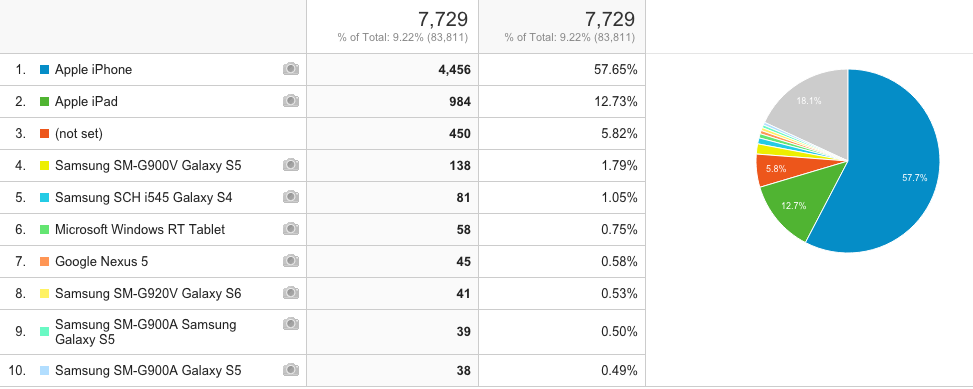
<p>Note that <strong>mobile is 9.2% of web traffic</strong>. To round some numbers, 58% of those devices are iPhones/iPods and 13% are iPads. So we’re looking at about 71% of mobile traffic (about 6.5% of <em>all</em> web traffic) from Apple devices. Dang. After that, it’s a bit of a long tail of other device types.</p>

<p>To give context, about 7.2% of our overall traffic came from the Firefox browser. So we have more mobile users than Firefox users.</p>

<p><a href="/assets//2013-2024//2015/09/2015-devices.png"><img src="/assets//2013-2024//2015/09/2015-devices.png" alt="2015 mobile device breakdown" /></a></p>

<h2 id="2014">2014</h2>

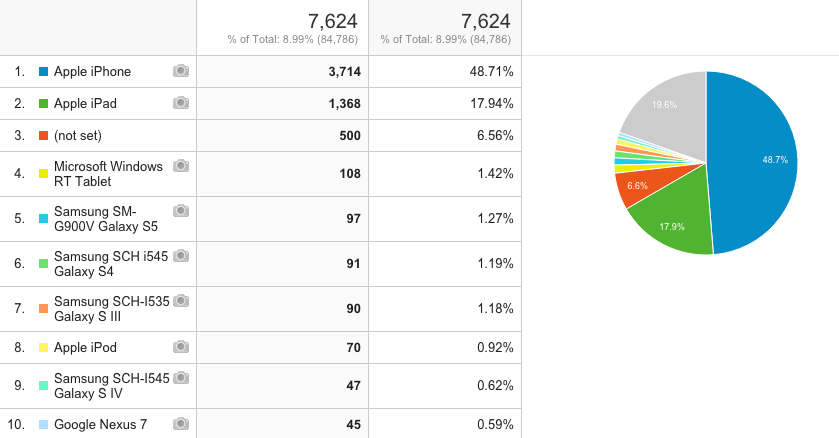
<p>Mobile jumped to 9% of all traffic this year. This is partially due to our retiring our mobile-only website in lieu of a responsive web design. As with the other years, at least 2/3 of the mobile traffic is an iOS device.</p>

<p><a href="/assets//2013-2024//2015/09/2014-devices.png"><img src="/assets//2013-2024//2015/09/2014-devices.png" alt="2014 mobile device breakdown" /></a></p>

<h2 id="2013">2013</h2>

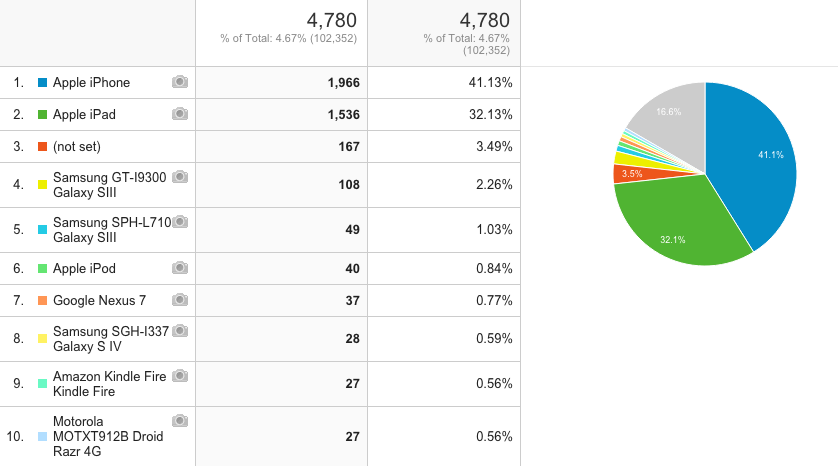
<p>Mobile was 4.7% of all traffic; iOS was 74% of all traffic; tablets, amazingly, were 32% of all mobile traffic.</p>

<p>I have one explanation for the relatively low traffic from iPhone: at the time, we had a separate mobile website that was catching a lot of traffic for handheld devices. Most phone users were being automatically redirected there.</p>

<p><a href="/assets//2013-2024//2015/09/2013-devices.png"><img src="/assets//2013-2024//2015/09/2013-devices.png" alt="2013 mobile device breakdown" /></a></p>

<h2 id="observations">Observations</h2>

<h3 id="browser-support">Browser support</h3>

<p>Nobody’s surprised that people are using their phones to access our sites. When we launched the new VCU Libraries website last January, the web team built it with a <a href="https://en.wikipedia.org/wiki/Responsive_web_design">responsive web design</a> that could accommodate browsers of many shapes and sizes. At the same time, we decided which desktop browsers to leave behind – like Internet Explorer 8 and below, which we also stopped fully supporting when we launched the site. Looking at stats like this helps us figure out which devices to prioritize/test most with our design.</p>

<h3 id="types-of-devices">Types of devices</h3>

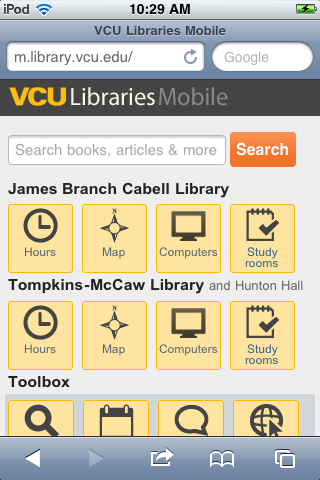
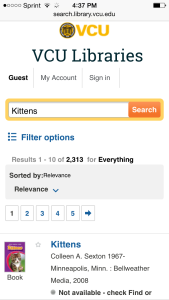
<p><a href="/assets//2013-2024//2015/09/1-mobile-homepage.png"><img src="/assets//2013-2024//2015/09/1-mobile-homepage.png" alt="VCU Libraries mobile circa 2011" /></a>Though it’s impossible to test on every device, we have targeted most of our mobile development on iOS devices, which seems to be a direction we should keep going as it catches a majority of our mobile users. It would also be useful for us to look at larger-screen Android devices, though (any takers?). With virtual testing platforms like <a href="http://www.browserstack.com">BrowserStack</a> at our disposal we can test on many types of devices. But we should also look at ways to test with real devices and real people.</p>
<h3 id="content">Content</h3>

<p>Thinking broadly about strategy, making special mobile websites/m-dots doesn’t make sense anymore. People want full functionality of the web, not an oversimplified version with only so-called “on-the-go” information. Five years ago when we debuted our mobile site, this might’ve been the case. Now people are doing everything with their phones–including writing short papers, according to our personas research a couple years ago. So we should keep pushing to make everything usable no matter the screen.</p>]]></content><author><name>erinrwhite</name></author><category term="libraries" /><category term="ux" /><category term="ia" /><summary type="html"><![CDATA[This week I took a look at mobile phone usage on the VCU Libraries website for the first couple weeks of class and compared that to similar time periods from the past couple years.]]></summary></entry><entry><title type="html">Easier access for databases and research guides at VCU Libraries</title><link href="https://erinrwhite.com/easier-access-for-databases-and-research-guides-at-vcu-libraries/" rel="alternate" type="text/html" title="Easier access for databases and research guides at VCU Libraries" /><published>2015-01-07T15:00:10+00:00</published><updated>2015-01-07T15:00:10+00:00</updated><id>https://erinrwhite.com/easier-access-for-databases-and-research-guides-at-vcu-libraries</id><content type="html" xml:base="https://erinrwhite.com/easier-access-for-databases-and-research-guides-at-vcu-libraries/"><![CDATA[<p>Today VCU Libraries launched a couple of new web tools that should make it easier for people to find or discover our library’s databases and research guides.</p>

<p>This project’s goal was to help connect “hunters” to known databases and help “gatherers” explore new topic areas in databases and research guides<sup><a href="#footnote1">1</a></sup>. Our web redesign task force identified these issues in 2012 user research.</p>

<h2 id="1-new-look-for-the-databases-list">1. New look for the databases list</h2>

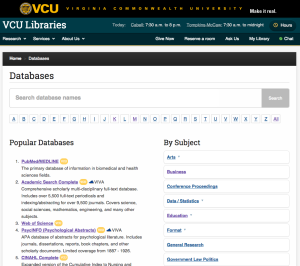
<p>Since the dawn of library-web time, visitors to our <a href="https://apps.library.vcu.edu/dblist/">databases landing page</a> were presented with an A to Z list of hundreds of databases with a list of subject categories tucked away in the sidebar.</p>

<p><a href="https://apps.library.vcu.edu/dblist/"><img src="/assets//2013-2024//2015/01/Screen-Shot-2015-01-06-at-4.07.58-PM-300x266.png" alt="new db list" /></a>The new design for the databases list presents a few ways to get at databases, in this order:</p>

<p><strong>For the hunters:</strong></p>

<ul>
  <li>Search by title with autocomplete (new functionality)</li>
  <li>A to Z links</li>
</ul>

<p><strong>For the gatherers:</strong></p>

<ul>
  <li>Popular databases (new functionality)</li>
  <li>Databases by subject</li>
</ul>

<p>And, on <a href="https://apps.library.vcu.edu/dblist/category/77">database subject pages</a> and <a href="https://apps.library.vcu.edu/dblist/search?q=medicine">database search results</a>, there are links to related research guides.</p>

<h2 id="2-suggested-results-for-search">2. Suggested results for search</h2>

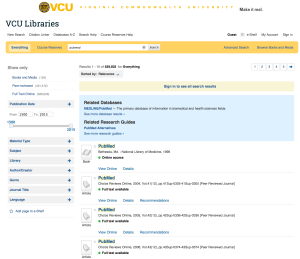
<p>Building on the search feature in the new database list, we created an AJAX Google Adwords-esque add-on to our search engine (Ex Libris’ Primo) that recommends databases or research guides results based on the search query. For longer, more complex queries, no suggestions are shown.</p>

<p><img src="/assets//2013-2024//2015/01/Screen-Shot-2015-01-06-at-4.19.18-PM-300x259.png" alt="suggested results" />Try these queries:</p>

<ul>
  <li><a href="http://search.library.vcu.edu/primo_library/libweb/action/dlSearch.do?institution=VCU&amp;vid=VCU&amp;search_scope=all_scope&amp;dym=true&amp;query=any,contains,cinahl">cinahl</a></li>
  <li><a href="http://search.library.vcu.edu/primo_library/libweb/action/dlSearch.do?institution=VCU&amp;vid=VCU&amp;search_scope=all_scope&amp;dym=true&amp;query=any,contains,dissertations">dissertations</a></li>
  <li><a href="http://search.library.vcu.edu/primo_library/libweb/action/dlSearch.do?institution=VCU&amp;vid=VCU&amp;search_scope=all_scope&amp;dym=true&amp;query=any,contains,psycinfo">psycinfo</a></li>
  <li><a href="http://search.library.vcu.edu/primo_library/libweb/action/dlSearch.do?institution=VCU&amp;vid=VCU&amp;search_scope=all_scope&amp;dym=true&amp;query=any,contains,art+history">art history</a></li>
  <li><a href="http://search.library.vcu.edu/primo_library/libweb/action/dlSearch.do?institution=VCU&amp;vid=VCU&amp;search_scope=all_scope&amp;dym=true&amp;query=any,contains,surgery">surgery</a></li>
  <li><a href="http://search.library.vcu.edu/primo_library/libweb/action/dlSearch.do?institution=VCU&amp;vid=VCU&amp;search_scope=all_scope&amp;dym=true&amp;query=any,contains,video+games+violence">video games violence</a> (no matches)</li>
</ul>

<p>Included in the suggested results:</p>

<ul>
  <li><a href="https://apps.library.vcu.edu/dblist/">Database</a> titles and descriptions, which are being indexed in the VCU Libraries search engine</li>
  <li><a href="http://guides.library.vcu.edu/">Subject guide</a> and <a href="http://guides.library.vcu.edu/home/howdoi">How do I… guide</a> titles using the LibGuides 1.0 API</li>
</ul>

<h2 id="3-updates-to-link-pathways-for-databases">3. Updates to link pathways for databases</h2>

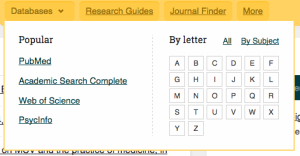
<p>To highlight the changes to the databases page, we also made some changes to how we are linking to it. Previously, our homepage search box linked to popular databases, the alphabet characters A through Z, our subject list, and “all”.</p>

<p><img src="/assets//2013-2024//2015/01/Screen-Shot-2015-01-06-at-12.51.22-PM-300x156.png" alt="old A-Z links" /></p>

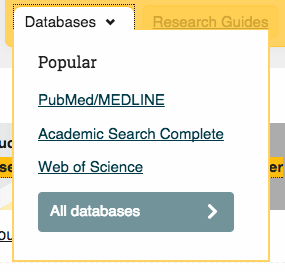
<p>The intent of the new design is to surface the new databases list landing page and wean users off the A-Z interaction pattern in lieu of search.</p>

<p><img src="/assets//2013-2024//2015/01/Screen-Shot-2015-01-06-at-12.50.20-PM.png" alt="Screen Shot 2015-01-06 at 12.50.20 PM" /></p>

<p>The top three databases are still on the list both for easy access and to provide “information scent” to clue beginner researchers in on what a database might be.</p>

<p>Dropping the A-Z links will require advanced researchers to make a change in their interaction patterns, but it could also mean that they’re able to get to their favorite databases more easily (and possibly unearth new databases they didn’t know about).</p>

<h2 id="remaining-questionsissues">Remaining questions/issues</h2>

<ul>
  <li>Research guides search is just okay. The results are helpful a majority of the time and wildly nonsensical the rest of the time. And, this search is slowing down the overall load time for suggested results. The jury is still out on whether we’ll keep this search around.</li>
  <li>Our database subject categories need work, and we need to figure out how research guides and database categories should relate to each other. They don’t connect right now.</li>
  <li>We don’t know if people will actually <em>use</em> the suggested search results and are not sure how to define success. We are tracking the number of clicks on these links using Google Analytics event tracking – but what’s good? How do we know to keep this system around?</li>
  <li>The change away from the A-Z link list will be disruptive for many and was not universally popular among our librarians. Ultimately it should be faster for “hunters”, but we will likely hear groans.</li>
  <li>The database title search doesn’t yet account for common and understandable misspellings<sup><a href="#footnote2">2</a></sup> of database names, which we hope to rectify in the future with alternate titles in the metadata.</li>
</ul>

<h2 id="necessary-credits">Necessary credits</h2>

<p><strong>Shariq Torres</strong>, our web engineer, provided the programming brawn behind this project, completely rearchitecting the database list in Slim/Ember and writing an AJAX frontend for the suggested results. Shariq worked with systems librarians <strong>Emily Owens</strong> and <strong>Tom McNulty</strong> to get a Dublin Core XML file of the databases indexed and searchable in Primo. Web designer <strong>Alison Tinker</strong> consulted on look and feel and responsified the design for smaller-screen devices. A slew of <strong>VCU librarians</strong> provided valuable feedback and QA testing.</p>

<hr />

<ol>
  <li>I believe this hunter-gatherer analogy for information-seeking behaviors came from Sandstrom’s <a href="http://www.jstor.org/stable/4308969">An Optimal Foraging Approach to Information Seeking and Use</a> (1994) and have heard it in multiple forms from smart librarians over the years.</li>
  <li>Great info from Ken Varnum’s <a href="http://www.lib.umich.edu/blogs/library-tech-talk/database-names-are-hard-learn">Database Names are Hard to Learn</a> (2014)</li>
</ol>]]></content><author><name>erinrwhite</name></author><category term="libraries" /><category term="ux" /><category term="ia" /><summary type="html"><![CDATA[Today VCU Libraries launched a couple of new web tools that should make it easier for people to find or discover our library’s databases and research guides.]]></summary></entry><entry><title type="html">A new look for search at VCU Libraries</title><link href="https://erinrwhite.com/a-new-look-for-search-at-vcu-libraries/" rel="alternate" type="text/html" title="A new look for search at VCU Libraries" /><published>2014-08-01T13:00:49+00:00</published><updated>2014-08-01T13:00:49+00:00</updated><id>https://erinrwhite.com/a-new-look-for-search-at-vcu-libraries</id><content type="html" xml:base="https://erinrwhite.com/a-new-look-for-search-at-vcu-libraries/"><![CDATA[<p>This week we launched a new design for <a href="http://search.library.vcu.edu/">VCU Libraries Search</a> (our instance of <a href="http://www.exlibrisgroup.com/category/PrimoOverview">Ex Libris’ Primo</a> discovery system). The guiding design principles behind this project:</p>

<ol>
  <li><a href="https://developer.apple.com/library/mac/documentation/userexperience/conceptual/applehiguidelines/HIPrinciples/HIPrinciples.html#//apple_ref/doc/uid/TP30000353-CJBDDFAJ">Mental models</a>: Bring elements of the search interface in line with other modern, non-library search systems that our users are used to. In our case, we looked to e-commerce websites as a model for some search design patterns. The context is not a perfect 1:1 match, but the comparisons proved useful.</li>
  <li><a href="http://www.usabilityfirst.com/glossary/aesthetic-integrity/">Aesthetic Integrity</a>: make the visual design more coherent, consistent, and attractive.</li>
  <li><a href="http://en.wikipedia.org/wiki/Progressive_disclosure">Progressive disclosure</a>: make the system more approachable for novice users by simplifying the interface, while keeping options for advanced users available on demand. The <a href="https://developer.apple.com/library/mac/documentation/userexperience/conceptual/applehiguidelines/UEGuidelines/UEGuidelines.html">Apple Human Interface Guidelines</a> explain this concept well.</li>
</ol>

<h2 id="before-and-after">Before and after</h2>

<p><a href="/assets//2013-2024//2014/07/old-search1.jpeg"><img src="/assets//2013-2024//2014/07/old-search1-300x188.jpeg" alt="old-search" /></a> <a href="/assets//2013-2024//2014/07/new-search.png"><img src="/assets//2013-2024//2014/07/new-search-300x185.png" alt="new-search" /></a></p>

<p>Following our guiding principles, we:</p>

<ul>
  <li>Hid many elements, most of them text elements.</li>
  <li>Added expand/collapse functionality to the left-hand facet list, with the exception of the date facet, which remained open.</li>
  <li>Incorporated <a href="https://github.com/ndlib/primo-date-slider">Notre Dame’s improvements to the date slider</a>.</li>
  <li>Gave the facet lists and the search result items more visual breathing room.</li>
  <li>Standardized fonts and text sizes.</li>
  <li>Added VCU branding and colors and incorporated fonts and design themes from the main VCU Libraries website.</li>
  <li>Made the pagination links bigger for fat fingers/clickers.</li>
  <li>Optimized for tablets and handheld devices.</li>
</ul>

<h2 id="optimizing-for-mobile">Optimizing for mobile</h2>

<h3 id="tablet">Tablet</h3>

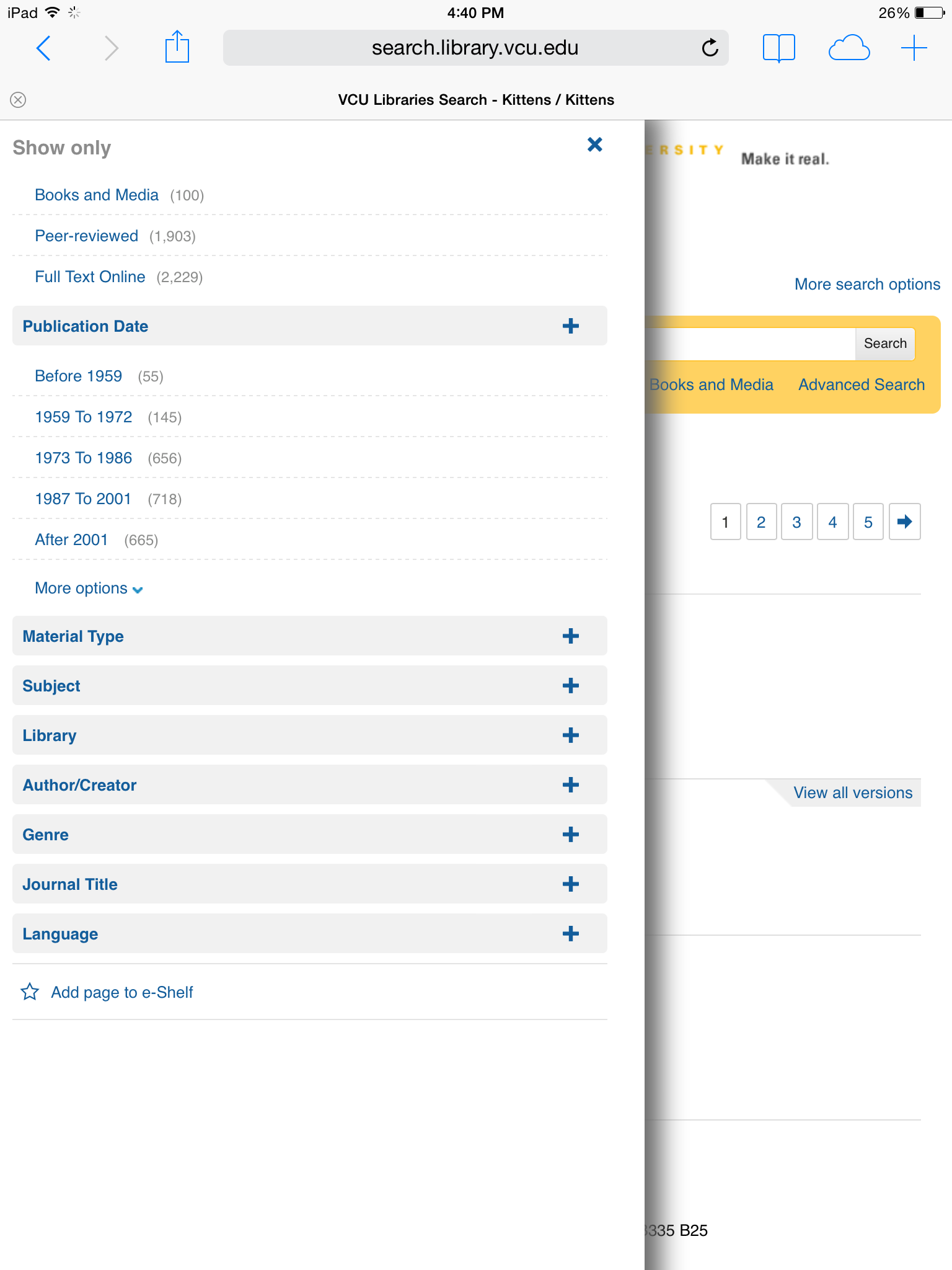
<p>On the tablet view, facets are hidden and slide out into view when the “filter options” link is selected. We chose the “filter” wording based on language we saw on a few mobile-enabled shopping websites, particularly Target and Amazon. Links to more search options (new search, databases, citation linker) are collapsed into a dropdown menu. Advanced options are there, just another click away. Because the date slider does not work on touch devices, we’ve hidden it and replaced it with a text list.</p>

<p><a href="/assets//2013-2024//2014/07/tablet.png"><img src="/assets//2013-2024//2014/07/tablet-225x300.png" alt="tablet" /></a> <a href="/assets//2013-2024//2014/07/tablet-search-options.png"><img src="/assets//2013-2024//2014/07/tablet-search-options-225x300.png" alt="tablet-search-options" /></a> <a href="/assets//2013-2024//2014/07/tablet-filter.png"><img src="/assets//2013-2024//2014/07/tablet-filter-225x300.png" alt="tablet-filter" /></a></p>

<h3 id="handheld">Handheld</h3>

<p><img src="/assets//2013-2024//2014/07/handheld-169x300.png" alt="handheld" />For the handheld view, we removed the advanced search and citation linker options entirely. I’d like to bring them back when their layout is better optimized for smaller screens. The link to filter results is prominent, and the juicier pagination links are especially helpful on the smaller screen. Our institutional branding is still there but centered and ensmallened.</p>

<h2 id="next-steps">Next steps</h2>

<p>We’re only in the first week of this new interface but already feel that it’s a vast improvement over the previous design. In the next few months we’ll solidify our development/deployment process and refine, refine, refine. I’d like to do some usability assessments of the interface as well.</p>

<h2 id="credits">Credits</h2>

<p>This was truly a collaborative effort between our web team and enterprise systems team. Web designer Alison Tinker worked closely with systems librarian Emily Owens to get the technical details just right. Tom McNulty and I helped frame the project and consult on design questions. And many librarians across the organization gave helpful feedback in our demo session and on our blog posts (many people saying “you should hide more stuff”, which I deeply appreciate).</p>

<h2 id="code">Code</h2>

<p>For our own sanity and maintainability’s sake, no JSP files were harmed in the making of this redesign. The CSS and Javascript <a href="https://github.com/vculibraries/alma-primo-customizations">customizations for this redesign are up on GitHub</a>.</p>]]></content><author><name>erinrwhite</name></author><category term="libraries" /><category term="ux" /><category term="ia" /><summary type="html"><![CDATA[This week we launched a new design for VCU Libraries Search (our instance of Ex Libris’ Primo discovery system). The guiding design principles behind this project:]]></summary></entry></feed>