Jekyll2025-05-05T15:38:55+00:00https://erinrwhite.com/feed/by_tag/richmond.xmlErin WhiteTech, Providence, UX, etc. etc.What it means to leave2024-03-23T20:17:47+00:002024-03-23T20:17:47+00:00https://erinrwhite.com/what-it-means-to-leaveIn early 2016 I posted What it means to stay, a rumination on staying put in my job long-term, building community, and switching into marathon mode in my workplace. I continue to hear from folks that it resonates with you.
This post is a follow-up: supporting my wife as she exited a harmful work situation, moving nine states away, changing careers, and finding professional footing again after a long run in higher ed and academic libraries.
What happened after I wrote that post
I stayed six more years at my job. During that time:
I was promoted from line librarian to department head and did some great work that I was proud of.
I married a fellow academic at my institution. Cue the two-body problem.
COVID hit and, like many folks, I reassessed my career.
Meanwhile, my wife’s working conditions became untenable.
She went on the market and got a great job offer.
We moved nine states away.
I left my job and changed career fields twice in two years.
We made our move in 2022, and it has taken me almost two years to write this post. Writing it has been healing. It’s still not where I want it to be, but I need to just publish it so I can write about other things.
Giving myself permission to go
How did this happen? Things moved slowly ‘til they didn’t.
The COVID career reassessment
Our rapid shift to work-from-home during COVID made me realize not only that I could work from home, but that I loved it. Remote work gave me more separation between work and my personal life, not less. At the end of each day, I’d sign off work, close my laptop, and walk immediately into the kitchen to make dinner. During a time of unceasing chaos in the world, I had the immense privilege of this centering routine. It’s something I still cherish being able to do.
Go high, go deep, or get out
In the midst of intersecting global crises, a pandemic and an insurrection, I also increasingly struggled to feel that the work I was doing every day mattered. I didn’t want to climb the ladder any further, and I knew that if I wanted to leave my specialized field, it needed to happen soon.
In my post eight years ago, I wrote about a friend telling me I could “go high or go deep” in my career. Over time, I realized there was a third option: to just go.
Letting go of the idea of a career arc
I started to do research. I met with generous friends and friends-of-friends who had been working in the private sector for years. I learned the language that people used to describe their work, and how they framed problems they were trying to solve. It sounded interesting and not totally dissimilar from my experience.
I slowly began to detach myself from the idea that my career needed to go in a straight line. I gave myself permission to go, and to try something new.
The two-body problem
While I was exploring my exit from academia, my wife’s working conditions at our university continued to deteriorate, even and especially after she got tenure. Though my situation in the library was better, her experience affected me, too. It had real consequences for both of our health and well-being. I also felt disappointed and frustrated with the institution for overworking, ignoring, and ultimately turning its back on my wife.
By the time my wife got her new job offer, we’d both gotten our heads where they needed to be for us to move on. It was time to go.
Making the move
Things really fell into place once we decided to go, which made the transition a lot easier. Within a month, we sold a house, bought a house, and I got a fully remote job at a small consultancy (based partly on the connections I’d made at my library job). Moving is hard enough; we were lucky that it went as smoothly as it could have.
The hardest thing was leaving our people
The featured image for this post is a photo of our dear neighbors gathering early in the morning of our moving day to hug us and send us on our way.
Almost two years later, saying goodbye is still the part that physically aches to think about. Leaving our jobs was relatively easy; leaving the home we’d created and our web of love and support – friends, neighbors, and colleagues – hurt the most. My wife and I had collectively spent 21 years creating our community in Richmond. It was heartbreaking to go.
The second hardest thing was the identity crisis
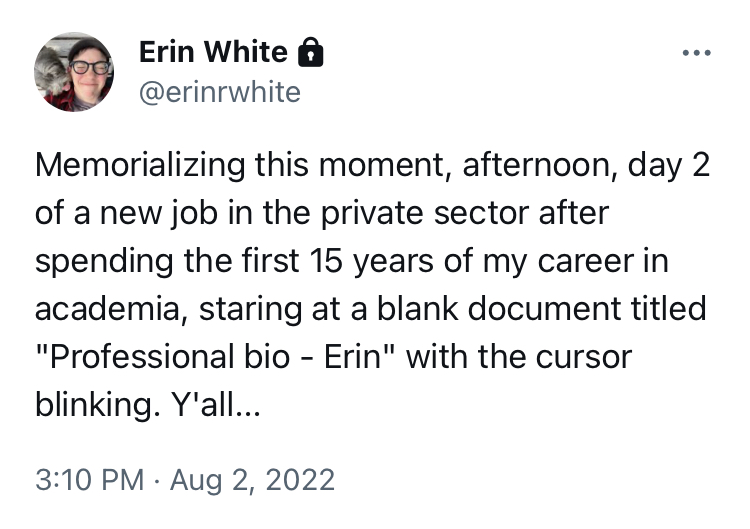
Skip forward to the move. My wife and I were navigating big changes together: new part of the country, new city, new home, new jobs. Along with all of these big changes came some seismic identity shifts for me as I stepped into a new workplace.
For years prior, I told myself I had a distinct identity separate from my career in libraries, and to some degree, I did. But my professional identity crisis after leaving higher ed was still intense and painful.
Finding legibility
Academic librarianship was such a tidy professional identity for me. I’d established myself in my field, was a respected leader at my institution, and was confident in my work. My wife was an academic, too. Many of our friends worked at the university where we worked. All of it fit so neatly together before. Now that I wasn’t in libraries or in higher ed, what was I?
Changing career fields, I struggled to find a new way to relate to my professional identity and tell my story in a way that was legible not only to others, but to me.
This took a long time and is still a work in progress. But it was a potent and necessary reminder that I needed to embrace that I am a person who exists outside of the work I do.
Releasing the expectations
Despite the professional identity crisis, I also felt a deep sense of relief when I was able to release the expectations I didn’t even know I was holding for myself.
I stopped worrying (or even thinking) about many of the things I had found extremely important when I was working in libraries. I felt guilty, but when I could viscerally sense the tension releasing in my body, the guilt turned to relief. I exhaled. I imagine this is what it’s like for many people when they retire.
New to the job, but not new to work
Starting a new job in an entirely new field after 13 years at the same employer was scary. I wasn’t entirely sure I had the experience to do the job well, and was worried that I was stuck in my ways. By the end of the first week, though, I saw obvious areas where I could plug in and realized I brought lots of skills along with me.
Transferable skills
Many folks who have left libraries and higher ed have talked about transferable skills. Some, in particular, that I carried with me into the private sector:
Talking with people and building relationships
Managing projects and stakeholders
Recruiting, hiring, retaining, rewarding, and managing people
Facilitating meetings and workshops, and presenting to groups of all sizes
Writing for different audiences, including communicating “professionally”
Mapping out, clarifying, and streamlining workflows
Strategic planning
Understanding how technologies connect and how the internet works
Putting theory into practice for diversity, equity, inclusion and accessibility
Instructional design, web design, writing for the web, working with legacy processes and systems, data analysis, research, and so much more.
Same shit, different context
The biggest transferable skill I brought with me, though, was perspective.
I spent the first part of my career learning how to navigate ambiguity, see the forest as well as the trees, build relationships, and create good work I was proud of. Entering new workspaces, I realized I’d learned how to read patterns, relationships, power structures, issues and assets in a much different way, and to identify what was going on at an organizational level. No matter where I went, I had the maturity and x-ray vision of someone who’d seen things. I also had a much stronger sense of where I wanted my boundaries to be, and I stuck to ’em.
Knowing myself
After well over a decade of working full time, I also felt at ease about who I was, what I did and didn’t bring, and where I needed to grow. I wasn’t afraid to say “I don’t know.” Though I was apprehensive about starting something new, I was less self-conscious than I was when I first entered the professional world. I very much owned my mid-career status, rather than feeling like a total newbie.
And because all my coworkers were new to me, not folks I had worked with since I was 24, they didn’t see me as a newbie, either.
Beginner’s brain
My new company’s culture was extremely welcoming for newcomers, and I felt supported to be completely honest about how this was a big transition and a learning curve for me.
Rather than seeing me just as someone who needed to be brought up to speed, my new coworkers saw my newness as a value-add. They asked what I thought as someone with fresh eyes on the business, and we ended up implementing several changes early on based on my ideas.
It also felt refreshing to be very new at something, to feel that uncertainty again for the first time in a while, and to remind myself that this was something I was capable of handling.
I also relished learning about how businesses work, which would help me later on when (much to my own surprise) I started my own business. I felt new synapses firing.
The second quarter of my career
Early on at my new job, a coworker explained her move to our company as “the way I wanted to spend the last quarter of my career.” My coworker had carefully chosen where she wanted to spend her last few years in the workforce. She wasn’t putting pressure on herself to follow a certain career progression.
Thinking of work-life as a series of strategic moves, rather than a graph going forever up, resonated with me. Thanks to my new colleague I had words for what was happening. I was starting the second quarter of my career.
A final note on leaving academia
> Anyway, all I ever meant by “the institution cannot love you” was this: whether the institution makes you feel great or horrible, it isn’t about you. Institutions aren’t choosing NOT to love you. They are choosing to reproduce themselves.
>
> Tressie McMillan Cottom
Many smart folks have written about leaving academia. Academic and cultural heritage institutions anywhere are going to do one thing for certain: self-perpetuate at all costs. “Institutions gonna institution” is a common refrain at our house.
The more I moved into leadership positions at my previous institution, the pricklier I felt about maxims like “the institution cannot love you”, because it felt personal. But it’s not personal. Academic and cultural heritage institutions thrive when employees believe these falsehoods:
You’ll need an outside offer if you dare to ask for a raise.
If you just follow the right administrative process, justice will be served.
The institution cares about you and will protect you.
My wife’s situation brought a lot of this into sharp focus for me. I realized that, especially as a middle manager, I had believed and perpetuated many of these myths for years. Leaving academia helped me see this all more clearly and learn what’s important for me.
My departure from academia made space for my wife to heal, too. Though she’s still in higher ed, her workplace is unionized, and she has far more protections than before. And because I’ve got a foot planted firmly outside of academia, we are both a little more more grounded, hopeful and happy.
This story is to be continued. Maybe there’ll be another update in 2032. Stay tuned.
Resources
For folks sticking around to fight the good fight in higher ed: the United Campus Workers Union continues to grow its power.
I’ve started, and continue to update, a guide to getting a job outside of academia, in part because so many folks have reached out for advice. Perhaps you’ll find it useful too.
Some related posts from former cultural heritage workers that have helped me a lot:
]]>erinrwhiteA bit of an update2023-01-20T22:00:42+00:002023-01-20T22:00:42+00:00https://erinrwhite.com/a-bit-of-an-updateIt’s been a whirlwind year in our household. My wife got a job as an associate professor at RISD, so we both put in our notice at VCU, picked up sticks and moved our household to Providence, RI. I’ve moved out of libraries and academia (for the most part…) and am working at a Richmond-based diversity, equity and inclusion consultancy. I still moonlight each fall as an adjunct instructor of Information Architecture at UTK. We miss our beloved community in Richmond and at VCU, but have been enjoying new things in Providence.
After 13 years in Richmond and at VCU, I didn’t see myself moving – let alone leaving the South! – but it has been invigorating and restorative to make this change. We can do hard things.
]]>erinrwhiteCode4Lib 2021 lightning talk: Planning for the most; or, a bellwether speaks2023-01-20T21:55:29+00:002023-01-20T21:55:29+00:00https://erinrwhite.com/planning-for-the-mostI gave this 5-minute talk almost two years ago at Code4Lib 2021, but hadn’t yet shared it here. Slides are available through OSF; text is below. I’m no longer working at VCU, or in libraries, but wanted to share the talk here because this is something I continue to think about. Thanks for reading.
Planning for the most; or, a bellwether speaks
Hi folks,
…just a visit from your future, here. I’m the ram with the bell around its neck.
I’m Erin White. This is my 11th Code4Lib!
I’m head of digital engagement at VCU Libraries in Richmond, VA.
I’m also the interim digital collections librarian
…for the past five years or so.
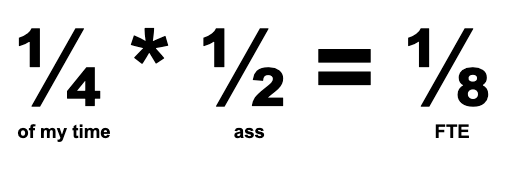
Interim math
Shoutout to everyone who’s holding an interim appointment or who has absorbed a vacancy in your area. I know many of y’all have been doing this math too. The past year in particular brought so much hardship across all vectors of our lives, and at work that likely included layoffs, retirements, health-related departures, and other stark changes.
I’m in a relatively good position – I get to say how much of this work has to get done. Still, it turns out half-assing a job for a quarter of my time means projects move really slowly or not at all. [2023 editor’s note: “half-assing” was sarcastically used here to mean, “Learning how to do a job I had not done before.” A reminder that we need to be kind to ourselves and others when we take on new roles!]
Where we’re headed
I’m not sharing this with you to complain. It’s not an indictment of my employer. I share it because I think this is where we’re headed.
The early 2000s were a boom time for mass digitization and library investment in digital collections. It was a time of huge growth and excitement in digital libraries.
But, y’all, library budgets are not getting bigger. It’s not that we’re temporarily in tough times. This is how things are and will be. It sure seems to me that digital collections work, and other types of important but invisibilized work in the library, will continue to be deprioritized when budget conversations inevitably get tough. [2023 editor’s note: All this in a broader U.S. political and fiscal climate increasingly hostile to higher ed, libraries, and cultural heritage institutions.]
I won’t tell you not to hope, and fight, for the best.
I will tell you to plan for the worst. Or rather, to plan for the most. ‘Cause this is where most of us are heading. And it’s not necessarily the worst. It’s just different.
The last mile problem
There are a lot of ripple effects of disinvestment that I could talk about, but I only have a few minutes, so I’ll talk about the ones that haunt me most. 🙂
She talked about the last mile problem: the “largest hurdle we face in making things usable.” She gave many good examples and even wrote it up into a C4L journal article.
The bottom line is that many people don’t use services, even ones that are “best” for them, because they’re simply not usable.
The most beautiful bus stop
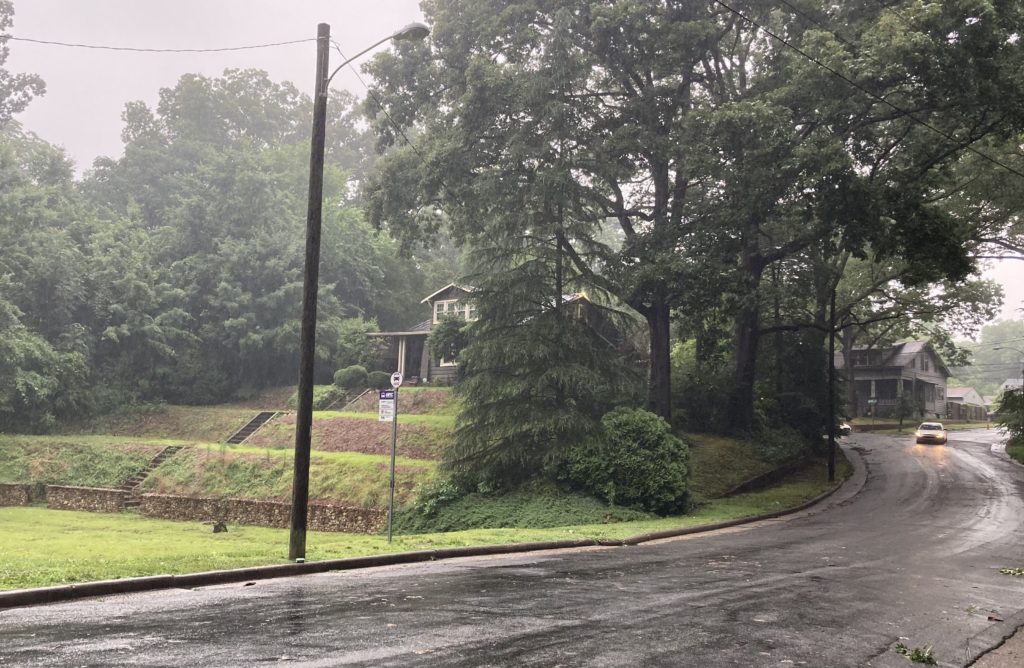
Here is a picture of the most beautiful bus stop in Richmond, VA. It’s my bus stop.
[2023 editor’s note: original slide text noted that there is no sidewalk, no bench, no shelter, and the stop is only serviced (unreliably) once per hour. This is still true.]
While this bus stop has the loveliest views, it has zero amenities. It’s inaccessible for many of my neighbors. And it only works well for me because I have a smartphone to check in on bus status, I have flexibility on what time I can arrive at my job, and I can walk quickly down a road with no sidewalk, dodging traffic, to catch a ride. If any of those things were to become untrue, or when the weather goes south, I can’t use the service easily.
This example is the very literal definition of the last mile problem.
The most beautiful workflows
One of the ways the last mile problem has manifested in my work-life has been that, even after a year and a half of using Islandora for our digital collections, we still haven’t figured out a workflow to batch-upload collections. We have added only one item to our digital collections since fall 2019.
First of all, as I said a few slides back, this is a result of disinvestment in libraries as a whole. Like many departments in our library, we’ve had a vacant position for years.
This is also, fundamentally, a last-mile problem. This upload process was designed assuming every institution had people with scripting expertise and, more importantly, time to design, code, and troubleshoot each bulk upload.
It feels personal. It’s not.
I am actually ashamed to admit this. I feel this failure in my body. I know that if I carved out two solid days I could probably get something working, right? It seems so fundamental! It should be simple. If I just tried harder. If I just had more time.
But this isn’t about me. This isn’t really about Islandora either. (BIG love and gratitude to the community of maintainers for Islandora. I know a lot of this is different in version 8. Again, this isn’t about Islandora.)
This is about beautiful bus stops that only a few people in good circumstances can use. We can and must design more usable things for each other.
Planning for the most
Design for the margins
Design for use
Assume nothing
Collaborate & de-silo
Define innovation as a social process rather than a technical one
So I ask you to think of this. How can we adjust the angle of our vision? To set our sights on each other instead of the distant horizon of another cutting-edge revolutionary technology that’ll solve all our problems?
What if instead of thinking of this as “planning for the worst” we see it instead as “planning for the most”? Because most of us are pressed for time, for money, for the brain cells to rub together to create new workflows.
By designing for needs of institutions that have fewer resources, we can design for everybody. Because the center is NOT holding. The dividing line between have- and have-not institutions is only getting stronger, with fewer in between.
Cultural heritage organizations must continue to become interdependent with each other as time goes along. Consortial, collectively-held platforms and communities are the way we need to go. Code4Lib itself is a model of how this can work. We can make this work!
So consider this an invitation.
Let’s keep building the future we need, together.
Postscript
This talk was inspired by all of my amazing colleagues doing library tech and digital collections work, and by the book Design Justice by Sasha Costanza-Chock. Thank you to Drew Heles at LYRASIS who reached out last year about this presentation and inspired me to post it.
When I gave this talk in March 2021, I got some feedback that it was too gloomy. After 13 years in the field, and well over a year after giving this talk, I stick by it. My takeaway is actually not gloomy at all; it’s hopeful. I believe we can have proactive new visions for the future instead of waiting for things to improve. No way out but through, no way through but together.
In the time since this talk I have left libraries and moved to a new city. My (former) institution is currently hiring a digital collections librarian.
Thanks again for reading.
]]>erinrwhiteTalk: Using light from the dumpster fire to illuminate a more just digital world2021-04-16T14:27:12+00:002021-04-16T14:27:12+00:00https://erinrwhite.com/talk-using-light-from-the-dumpster-fire-to-illuminate-a-more-just-digital-worldThis February I gave a lightning talk for the Richmond Design Group. My question: what if we use the light from the dumpster fire of 2020 to see an equitable, just digital world? How can we change our thinking to build the future web we need?
Hi everybody, I’m Erin. Before I get started I want to say thank you to the RVA Design Group organizers. This is hard work and some folks have been doing it for YEARS. Thank you to the organizers of this group for doing this work and for inviting me to speak.
This talk isn’t about 2020. This talk is about the future. But to understand the future, we gotta look back.
The web in 1996
Travel with me to 1996. Twenty-five years ago!
I want to transport us back to the mindset of the early web. The fundamental idea of hyperlinks, which we now take for granted, really twisted everyone’s noodles. So much of the promise of the early web was that with broad access to publish in hypertext, the opportunities were limitless. Technologists saw the web as an equalizing space where systems of oppression that exist in the real world wouldn’t matter, and that we’d all be equal and free from prejudice. Nice idea, right?
You don’t need to’ve been around since 1996 to know that’s just not the way things have gone down.
Pictured before you are some of the early web pioneers. Notice a pattern here?
These early visions of the web, including Barlow’s declaration of independence of cyberspace, while inspiring and exciting, were crafted by the same types of folks who wrote the actual declaration of independence: the landed gentry, white men with privilege. Their vision for the web echoed the declaration of independence’s authors’ attempts to describe the world they envisioned. And what followed was the inevitable conflict with reality.
We all now hold these truths to be self-evident:
The systems humans build reflect humans’ biases and prejudices.
We continue to struggle to diversify the technology industry.
Knowledge is interest-driven.
Inequality exists, online and off.
Celebrating, rather than diminishing, folks’ intersecting identities is vital to human flourishing.
The web we have known
Profit first: monetization, ads, the funnel, dark patterns Can we?: Innovation for innovation’s sake Solutionism: code will save us Visual design: aesthetics over usability Lone genius: “hard” skills and rock star coders Short term thinking: move fast, break stuff Shipping: new features, forsaking infrastructure
Let’s move forward quickly through the past 25 years or so of the web, of digital design.
All of the web we know today has been shaped in some way by intersecting matrices of domination: colonialism, capitalism, white supremacy, patriarchy. (Thank you, bell hooks.)
The digital worlds where we spend our time – and that we build!! – exist in this way.
This is not an indictment of anyone’s individual work, so please don’t take it personally. What I’m talking about here is the digital milieu where we live our lives.
The funnel drives everything. Folks who work in nonprofits and public entities often tie ourselves in knots to retrofit our use cases in order to use common web tools (google analytics, anyone?)
In chasing innovation™ we often overlook important infrastructure work, and devalue work — like web accessibility, truly user-centered design, care work, documentation, customer support and even care for ourselves and our teams — that doesn’t drive the bottom line. We frequently write checks for our future selves to cash, knowing damn well that we’ll keep burying ourselves in technical debt. That’s some tough stuff for us to carry with us every day.
The “move fast” mentality has resulted in explosive growth, but at what cost? And in creating urgency where it doesn’t need to exist, focusing on new things rather than repair, the end result is that we’re building a house of cards. And we’re exhausted.
To zoom way out, this is another manifestation of late capitalism. Emphasis on LATE. Because…2020 happened.
What 2020 taught us
Hard times amplify existing inequalities
Cutting corners mortgages our future
Infrastructure is essential
“Colorblind”/color-evasive policy doesn’t cut it
Inclusive design is vital
We have a duty to each other
Technology is only one piece Together, we rise
The past year has been awful for pretty much everybody.
But what the light from this dumpster fire has illuminated is that things have actually been awful for a lot of people, for a long time. This year has shown us how perilous it is to avoid important infrastructure work and to pursue innovation over access. It’s also shown us that what is sometimes referred to as colorblindness — I use the term color-evasiveness because it is not ableist and it is more accurate — a color-evasive approach that assumes everyone’s needs are the same in fact leaves people out, especially folks who need the most support.
We’ve learned that technology is a crucial tool and that it’s just one thing that keeps us connected to each other as humans.
Finally, we’ve learned that if we work together we can actually make shit happen, despite a world that tells us individual action is meaningless. Like biscuits in a pan, when we connect, we rise together.
Marginalized folks have been saying this shit for years.
More of us than ever see these things now.
And now we can’t, and shouldn’t, unsee it.
The web we can build together
Current state:
– Profit first
– Can we?
– Solutionism
– Aesthetics
– “Hard” skills
– Rockstar coders
– Short term thinking
– Shipping
Future state:
– People first: security, privacy, inclusion
– Should we?
– Holistic design
– Accessibility
– Soft skills
– Teams
– Long term thinking
– Sustaining
So let’s talk about the future. I told you this would be a talk about the future.
Like many of y’all I have had a very hard time this year thinking about the future at all. It’s hard to make plans. It’s hard to know what the next few weeks, months, years will look like. And who will be there to see it with us.
But sometimes, when I can think clearly about something besides just making it through every day, I wonder.
What does a people-first digital world look like? Who’s been missing this whole time?
Just because we can do something, does it mean we should?
Will technology actually solve this problem? Are we even defining the problem correctly?
What does it mean to design knowing that even “able-bodied” folks are only temporarily so? And that our products need to be used, by humans, in various contexts and emotional states?
(There are also false binaries here: aesthetics vs. accessibility; abled and disabled; binaries are dangerous!)
How can we nourish our collaborations with each other, with our teams, with our users? And focus on the wisdom of the folks in the room rather than assigning individuals as heroes?
How can we build for maintenance and repair? How do we stop writing checks our future selves to cash – with interest?
Some of this here, I am speaking of as a web user and a web creator. I’ve only ever worked in the public sector. When I talk with folks working in the private sector I always do some amount of translating. At the end of the day, we’re solving many of the same problems.
But what can private-sector workers learn from folks who come from a public-sector organization?
And, as we think about what we build online, how can we also apply that thinking to our real-life communities? What is our role in shaping the public conversation around the use of technologies? I offer a few ideas here, but don’t want them to limit your thinking.
I don’t have a ton of time left today. I wanted to talk about public service like the very excellent Dana Chisnell here.
Like I said, I’ve worked in the public sector, in higher ed, for a long time. It’s my bread and butter. It’s weird, it’s hard, it’s great.
There’s a lot of work to be done, and it ain’t happening at civic hackathons or from external contractors. The call needs to come from inside the house.
Working in the public sector
Government should be
– inclusive of all people
– responsive to needs of the people
– effective in its duties & purpose
I want you to consider for a minute how many folks are working in the public sector right now, and how technical expertise — especially in-house expertise — is something that is desperately needed.
Pictured here are the old website and new website for the city of Richmond. I have a whole ‘nother talk about that new Richmond website. I FOIA’d the contracts for this website. There are 112 accessibility errors on the homepage alone. It’s been in development for 3 years and still isn’t in full production.
Bottom line, good government work matters, and it’s hard to find. Important work is put out for the lowest bidder and often external agencies don’t get it right. What would it look like to have that expertise in-house?
Influencing technology policy
We also desperately need lawmakers and citizens who understand technology and ask important questions about ethics and human impact of systems decisions.
My theory is, in addition to holding deep prejudices, lawmakers are also deeply baffled by technology. The hard questions aren’t being asked, or they’re coming too late, and they’re coming from citizens who have to put themselves in harm’s way to do so.
Technophobia is another harmful element that’s emerged in the past decades. What would a world look like where technology is not a thing to shrug off as un-understandable, but is instead deftly co-designed to meet our needs, rather than licensed to our city for 1.5 million dollars? What if everyone knew that technology is not neutral?
Closing
This is some of the future I can see. I hope that it’s sparked new thoughts for you.
Let’s envision a future together. What has the light illuminated for you?
Thank you!
]]>erinrwhiteThis car runs: Love letter to a 1997 Honda Accord2021-04-01T20:36:52+00:002021-04-01T20:36:52+00:00https://erinrwhite.com/this-car-runs-love-letter-to-a-1997-honda-accord
Three years ago I sold my 1997 Honda Accord DX. Here’s the Craigslist ad love letter I wrote to it.
1997 Honda Accord DX – 4dr, automatic – This car runs. – $500 (Richmond, VA)
1997 Honda Accord DX
4 door
4 cylinders
206,193 miles
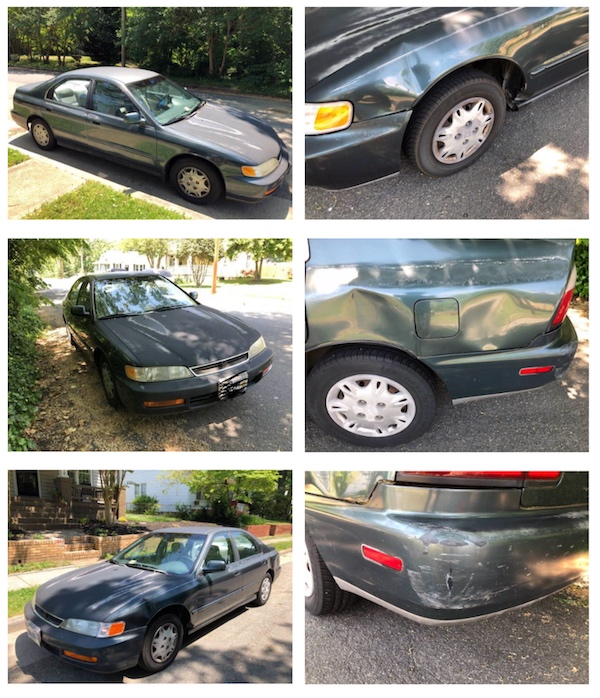
Color: “Eucalyptus green pearl” aka the color and year that paint sucks for Accords. See also: every other 1997 Honda Accord in eucalyptus green pearl that has thinning paint.
This car runs. I’m the second owner and have had this car since I was 16. I’m 33 now. We have truly had some TIMES together. I have laughed, cried, kissed, hugged, hollered, sang, sweated, shivered, and felt all possible feelings in this car. This car has carried all my friends, half my family, all my shit, and any number of other things. This car has moved my worldly possessions at least eleven times. This car has driven through rain, snow, sun, heat, cold, wind and high water. It’s visited most states east of the Mississippi. It knows the highways of the South well.
condition: fair
cylinders: 4
cylinders drive: fwd
fuel: gas
This car was my constant when everything else changed, but now I am ready to move on. My sweetie and I have moved in together and are ready to be a single-car household (with a newer Honda, natch). I’m not crying, YOU’RE crying.
This car runs. I would not put this car on the interstate without a look from a mechanic. City driving? Car-about-town? Absolutely. It sounds like it needs a new muffler (that would be its…fifth? muffler?). It was last inspected December 2016. I think it would pass inspection with only a couple hundred bucks’ worth of work. Or maybe it would pass without the work. I don’t know. I’m not a mechanic. But my mechanics at Edwards Auto Care on Cleveland and Broad LOVE this car and assure me it’ll last another 200k miles. It’s a Honda so I believe them. (The folks at Edwards have been good to me, so if you end up with this car I hope you’ll go to see them, too.)
1997 Honda Accord
odometer: 206193
paint color: green
size: midsize
title status: clean
transmission: automatic
type: sedan
Are you looking for a car that’s not that “”smart””? That doesn’t connect to any kind of cloud computer and doesn’t make decisions for you or warn you of imminent danger? That’s this car. It has aftermarket cruise control installed and it’s on its third stereo. BONUS: this stereo takes an aux-in cable so you can listen to your phone. Bluetooth? LOL. No.
Are you looking for a car you’ll never get locked out of? This car can’t lock all the way. The rear driver-side door doesn’t lock. To prove its point, the lock thingy broke off in my hand a couple years ago. Touche, car. When I park it I just act like it can lock and confidently walk away. I don’t leave valuables in it.
Speaking of security features: this car has two sets of keys. One unlocks the doors, the other starts the engine. This is a feature, not a bug.
Are you looking for a car that looks like it has 4 working doors, but only has 3? That’s this car. The rear passenger side door hasn’t opened since 2006. Why bother? That is the LEAST-used door anyway. One less thing to worry about.
One time I was buying a John Mayer CD at the K-mart in Prattville, AL, and when I came out this car had a dent in the front left panel. I never went to a K-Mart again and I no longer like John Mayer’s music. The dent is still there. There are some other scratches and scrapes on the bumpers which I’m pretty sure are my fault. The car runs fine.
This car has driven the length of I-85 more times than I can count. It’s never lived north of the Mason-Dixon and maybe it never will? I’m guessing the underside of the car is FINE because it hasn’t lived in a place where a city knows how to salt its roads (side-eyeing you, Richmond!).
I only got pulled over in this car once. I was 17 and I just got a warning. Somehow, miraculously, I have never been in an accident in this car either. May this good luck extend to you.
This car is what Kelly Blue Book would define as FAIR. I think it has a lot more life left in it with a new owner who will love it.
My dad bought this car from a 23-year-old divorcee in Wetumpka, AL, in 2001 for $10,300. Now, 150,000 miles and 17 years later, I’m asking for $500. WHAT A STEAL.
I’ll accept a lower offer if you tell me a good story about a car that meant a lot to you. I am also good and ready to give this car to the radio station and write it off on my damn taxes if y’all lowball me, so whatever.
Text me, don’t call. No lowballs, no slimeballs, if the ad is still up the car’s still available. I love you and thank you for reading this far.
UPDATE: My sweetie just returned from the grocery store and informed me that in an effort to park in the shade she bumper tapped the front of my car. It still runs fine.
Epilogue
A couple days after posting this ad, I got a VERY sweet, very long email from a college sophomore who had just had her wisdom teeth out. She spun an epic painkiller-induced yarn about her family’s old car. “Can you come by tomorrow?” I asked. “I’m getting married this afternoon.” It was a Thursday. On Friday the buyer and her dad came by with their standard poodle in tow and a bottle of champagne for us. They had called Edwards Auto Care who had lovingly vouched for the car. They gave the car a test run and decided to buy. It was a sweet farewell.
After being foiled by a long trip last year, I got the chance to attempt the Errandonnee challenge again this year (I attempted it in 2014, too). The challenge: complete 12 errands in 12 days and ride or run a total of 30 miles between March 4-15, 2016.
Fun twist: I was in Philadelphia and bikeless from Sunday, March 6-Thursday, March 10.
And yet: 12 errands, 6 distinct days, 61.4 miles. My bike was my old reliable, a 2012 Surly Cross-Check to which I’ve pledged my undying love.
Anyhow, here’s how the 12 errands shook out.
March 4
Commute – 2.8 miles – learned that Strava is cool. My first time using the app.
Social call – Asado – 1.7 miles – observed crazy traffic and learned to keep breathing, no need to rush.
Social call – Erin’s house – 2.4 miles – learned that Grace Street’s cobbles last a lot longer than I thought.
Arts/Entertainment – Lucy Dacus at the Broadberry – 2.7 miles – heard a really great cover of “Dancin’ in the Dark”. Learned that Richmond needs more bike parking infrastructure.
March 5
Shopping – Ellwoods – 2.2 miles – learned that I can eat a coconut macaroon in a disgusting record time.
You carried WHAT??? – Woodland Heights and back – 7.6 miles – learned that I can probably hold 6 or 7 irons in my bag (only carried 1 this time). Also, the James is beautiful and I wouldn’t mind seeing it every day.
March 10
Personal care: group ride with Bike!Bike! Southeast – 12.1 miles – observed some beautiful city views and met the folks from a bike co-op in West Virginia. It was warm and the group was big (maybe 40 people). Great way to get back on the bike after a few days away.
March 11
Commute one way – 1.4 miles – observed some extra traffic on the highway. Smooth sailing on the side streets.
Personal care – 2.4 miles – dinner with a friend after a long week. Learned that it takes an equal amount of time to get to Sticky Rice from VCU in a car or on a bike.
March 12
Wild Card: Bike!Bike! Southeast Scavenger Hunt – 13.4 miles – learned a lot more about some of our city streets and how to win at Mario video games. Super fun.
March 13
Store: Carytown Bikes by way of Hardywood – 4.5 miles – learned about a new anti-concussion helmet liner technology called MIPS and got John a helmet.
Wild card: Sunday afternoon roundabout – 8.2 miles – another afternoon spent entirely on the bike. Learned that 30% chance of rain sometimes means 100% chance of rain. Whoops!
Reflections
A couple years ago I reflected on how much more this challenge got me out on my bike. This year, I was really just recording the stuff I was doing on my bike anyway. It is truly a luxury to be able to bike everywhere, and I am grateful every day for it.
]]>erinrwhiteWhat it means to stay2016-02-11T16:43:23+00:002016-02-11T16:43:23+00:00https://erinrwhite.com/what-it-means-to-staySeven years ago last month I interviewed for my job at VCU. I started work a few months later, assuming I’d stick around for a couple of years then move on to my Next Academic Library Job. Instead I found myself signing closing papers on a house on my sixth work anniversary, having decided to root myself in my city and my job.
So what happened? What happens when you have a career in a field that expects you to move from job to job, city to city, climbing a ladder towards Career Success…and you stay instead?
Go high or go deep
Last year about this time I was hanging out with my friend Liz, who has spent over 10 years teaching at VCU. “I don’t know what’s next for me,” I said. “I feel like I am supposed to move on but I am happy here.”
“You either go high or you go deep,” she said. “Choose which one you want and follow that. You’ll have success either way.”
Liz’s advice resonates with me to this very day. By staying and growing in my job, I’m choosing to go deeper into my specialization rather than higher into an org chart. Rather than looking outward to the Next Job Opportunity, I’m freed up to focus on getting really good at what I do and helping my library grow.
So, ruminating on my time at my job:
I switched from sprint mode to marathon mode
When you run a longer distance you pace yourself, make sure your form is right, get your head in the right place, and focus far on the road ahead. At some point over the past couple years, I stopped deciding everything needed to happen at a breakneck speed. Yes, some things need to move quickly, but not everything. Pacing is important.
I fear being the one who fears change
Every day I worry that I’m becoming the person who says “no” because it’s a new way of doing things, or because the answer was no in the past. Being aware of this is part of the solution – as is really, truly listening to new ideas, even when they scare the shit out of me.
I try not to poison the well
I also worry that my cynicism about work problems from the past (even in the way-way past) can show through. Being aware of where and how often I direct my crankiness is key, as is wielding that ire when needed to address larger organizational issues that need attention.
I try to fix small things that can become big things
Switching from sprint mode to marathon mode means looking out for the parts that rub the wrong way. As when you do anything for a long time, the smallest discomforts can turn into big problems if not addressed early on.
I plan far ahead
Choosing to stay meant deeply investing in the future—the way-way future, not just the next year or two. All of a sudden, policy changes and organizational culture changes were very important to me and I started using my voice as such.
I benefit from relationships I’ve built
Over the years I’ve made a lot of connections inside and outside my library, around campus and all over Richmond. Knowing people and having that mutual respect really helps get my job done and collaborate with others better and in exciting ways. It also means I have the respect and trust of colleagues in the library, a power that I try to wield for good.
Other people benefit from relationships I’ve built
Knowing more people means I can make introductions. I’m very proud that I can say I’ve gotten people jobs and otherwise connected disparate folks who benefitted from meeting each other. This is a fun part of being a librarian and I’m hooked on it.
I learn from my younger self’s missteps
One of our favorite questions to ask candidates for web developer jobs is, “Have you ever worked on someone else’s code that was good?” The ideal answer, of course, is “I don’t even think my own code from two weeks ago is good.”
We keep learning, circumstances change, and besides, it’s foolish to think we’ll never make regrettable decisions. After almost 7 years I’ve dealt with the echoes of strategy and code decisions I made years before – both good and bad. Projects are cyclical, and when they come back around, it’s me looking at my past self’s decisions and sometimes saying, “I don’t even think my own decision from three years ago was good.” And that’s okay.
I’ve become kinder to my future self
I’ve begun documenting more, communicating more, and acknowledging that I am working with the best information I have at the time, so missteps are inevitable but okay. And more importantly, I’ve stopped thinking I am my work and vice versa. That’s a harmful way to think and it helps no one.
I mentor newer employees
My library has an informal “buddy” program to match new hires with experienced employees, and I’ve otherwise reached out to new librarians just to say hello and offer a listening ear or advice. Hopefully folks have found this useful, and in any case it gives me an excuse to introduce myself.
Newer employees mentor me
It’s not a one-way mentorship relationship. I love hearing ideas from people who just got hired; they bring in new experiences and fresh ideas that I just don’t have the capacity or experience to bring. When I hire people, I seek out people whose ideas scare me a little. It’s having people who are new that keeps us longer-timers engaged and challenged.
What does it mean for you?
For others who have stayed at your institution: what does that mean to you? How do you benefit and what are you cautious about?
Many thanks to John Glover and Wren Lanier for their early feedback on this post.
]]>erinrwhite2014 in review2015-01-06T22:55:37+00:002015-01-06T22:55:37+00:00https://erinrwhite.com/2014-in-review2014 was a big, brag-worthy year for me:
Traveled all over, celebrated birthdays, cried at weddings, and saw many wonderful friends and family.
Here’s to keeping up the momentum in 2015.
]]>erinrwhiteGifs-mas in New York2014-12-19T19:46:47+00:002014-12-19T19:46:47+00:00https://erinrwhite.com/gifs-mas-in-new-york
]]>erinrwhiteVacation photos with a disposable camera2014-05-16T15:45:28+00:002014-05-16T15:45:28+00:00https://erinrwhite.com/vacation-photos-with-a-disposable-cameraI took last week off and went on two short outdoorsy trips with friends. Rather than document the trips solely with my phone, as I’ve done lately, I decided to buy a couple of disposable film cameras and see how it went.
Sometime around 2004 I gave up film cameras and went all-digital. Ten years later, it was with a forgotten familiarity that I moved back to film for a few days. Here are a few of my thoughts as well as some of the photos that resulted. The full set is up on Flickr.
A disposable camera’s (lack of) affordances make it more difficult to use. I felt powerless to the camera. The viewfinder was small and didn’t accurately represent what I was photographing. I couldn’t instantly preview the photo I just took. I had to wind the film after each shot (or, as I learned after taking several accidental shots of the inside of my bike bag: wind it before the next shot). I couldn’t tell if the camera was focusing or not. I couldn’t take close-up photos. I couldn’t tell if I was actually in my one self-portrait or not. I couldn’t shoot in low light reliably without flash, as I was accustomed to with my iPhone. I was just shooting and hoping for the best.
Every photo counts. Literally. There was a counter on the camera. Each picture I took was one in a finite set, to be physically imprinted on film. I took longer to set up the shot, hold still, and press the shutter.
You have to go out of your way to buy and develop film nowadays. When I went in to buy the disposable cameras from CVS, most of the cameras and film in the store had expired in 2012 and 2013. My CVS location also didn’t develop film at all. It was almost impossible to find information on the CVS website about film developing services. When I walked in with the spent disposable cameras in my hand, the clerk just shook his head at me.
I didn’t care how long it took to develop the photos. The photos weren’t instantly available digitally, so it no longer mattered to me how long I actually waited to get the pictures developed. I dropped my photos off at Walgreen’s on Sunday and picked them up on Thursday. I could’ve gone to a one-hour photo place, but I wanted my photos digitized (more, in fact, than I wanted the prints). And, the one-hour place was across the river while Walgreen’s is only four blocks from my house.
It was expensive. I paid about $12/roll to develop one set of prints for each camera, with a “free” CD included. Compare that to what I’ve paid to print photos from my phone camera recently – 50 photos for $10, less than half the price of film developing.
The pictures are not great. I don’t think any of the roughly 50 photos were actually in focus, which should not be a big shock, given that the cameras I used were about $5.50 apiece. But I naively hoped that at least a few would turn out sharp.
I still feel more invested in these photos. They have a timeless quality about them, and there are a few memorable shots that I want to keep. And, this was a small art project for myself that went pretty well. I created something and learned from it.
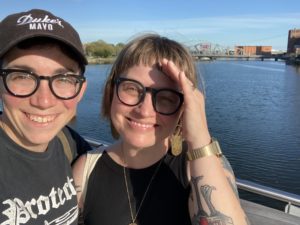 It’s been a whirlwind year in our household. My wife got a job as an associate professor at RISD, so we both put in our notice at VCU, picked up sticks and moved our household to Providence, RI. I’ve moved out of libraries and academia (for the most part…) and am working at a Richmond-based diversity, equity and inclusion consultancy. I still moonlight each fall as an adjunct instructor of Information Architecture at UTK. We miss our beloved community in Richmond and at VCU, but have been enjoying new things in Providence.