Jekyll2025-05-05T15:38:55+00:00https://erinrwhite.com/feed/by_tag/providence.xmlErin WhiteTech, Providence, UX, etc. etc.Finding a job outside of academia2025-04-27T00:00:00+00:002025-04-27T00:00:00+00:00https://erinrwhite.com/finding-a-job-outside-academiaThis page has been online in some form or another since 2023 and is now making its appearance on my dot-com. This page is in perpetual draft. Last updated April, 2025.
There are a lot of logistical and emotional components of job-hunting, applying, interviewing, and changing jobs. That part alone is hard, and it’s plenty to have to do. But also prepare yourself for the inevitable grief of leaving your field, as well as the identity shift that happens when you leave.
Do you want a job or a career? How much heart/soul can you put into your work?
Ask yourself if your career actually needs to have a trajectory.
Sometimes it just doesn’t make any sense. What does “career success” look like for you? If it looks like climbing a ladder, you are probably not reading this right now.
It doesn’t have to be a forever-job. It can be a for-now job.
It can be really easy to search for the dream job/company that you’ll stay at forever! Sometimes, though, you just need a job to get you started, to pivot into another field or get you experience doing X, Y, or Z. Don’t stress yourself out looking for a perfect forever job.
Find a job you could do, that pays you enough to live, and that gets you the experience you need.
Before you start applying for jobs, think about how you’d answer the question “tell us about yourself” in 1-2 minutes at the start of an interview. Tie your past work and interests to the thing that you want to do next. That is the story that you will tell your interviewers, your network on LinkedIn, and most importantly yourself as you’re moving through the job hunt process.
What artifacts do you have that can help you tell your story?
Things you’ve written: articles, blog posts, policies, strategy documents, memos, project plans
Presentations you’ve given
Projects you’ve initiated, led, or contributed significantly to
Any other artifacts that represent your work.
Do your research
Use your strong research skills to learn how things work outside of academia.
Do informational interviews
Ask friends and friends of friends for informational interviews. People are so very generous! A quick half-hour call will give you a lot of insight into what a person’s job and workplace is like, what kinds of things they’re responsible for, and even the words they use to talk about what they do. Soak it up.
See what others are doing
Dust off your LinkedIn account. Start searching for people who are talking about things you’re interested in. Follow them, and follow who they follow. You don’t have to “connect” with them if you don’t want; you can just follow their posts.
Look for jobs
By looking at job ads you can learn what types of words/phrases people are using to describe certain skills. Refine your search as you find new keywords in job postings.
All job ads are aspirational. You won’t have 100% of the qualifications for every job. If you have half the qualifications, apply.
I recommend starting a spreadsheet to track each role you’re interested in, whether you applied, the employer, a link to the job, your application status, when you applied, and any other notes you want to make (salary? concerns?)
Words of Mouth is a weekly email newsletter with job postings across the arts, digital jobs at nonprofits, etc. Also includes fellowships. This list is really tailored for GLAM/academic-adjacent folks.
LinkedIn is, unfortunately, a thing
LinkedIn is weirdly very important outside of higher ed, especially in the private sector.
Fill out your profile - add a brief bio (remember your story) and add more details about your responsibilities/accomplishments in previous/current work and volunteer experience.
Model your profile based on what others are doing - lurk and find folks whose profiles look good to you and note how they are using LinkedIn. Make any changes to your profile that feel authentic for you.
Make/strengthen connections - reach out to folks in your existing network and add new people that you know. LinkedIn is extremely creepy and knows who you know. Just add ‘em.
Ask for help - either as a post, or through messaging folks. Most folks are very eager to add connections, exchange messages, share links to jobs, offer referrals, and share information about their work.
The job market, especially in UX and adjacent fields in 2024, is awful 🙂. No matter what field you’re in, though, be prepared to be ghosted at any point in the application process. Don’t take it personally.
Transferable skills
Your skills are transferable!
Here are some transferable skills I identified for myself:
Talking with people and building relationships
Managing projects and stakeholders
Recruiting, hiring, retaining, rewarding, and managing people
Facilitating meetings and workshops, and presenting to groups of all sizes
Writing for different audiences, including communicating “professionally”
Mapping out, clarifying, and streamlining workflows
Strategic planning
Understanding how technologies connect and how the internet works
Putting theory into practice for diversity, equity, inclusion and accessibility
Here are a few terms that might help in translating your skills for a new context:
Academic word
Private sector word
Translation
Faculty member
SME
SME = Subject matter expert. Someone who knows a lot about a specific topic.
Administrators, deans, provosts
Executive leadership, C suite
In the private sector, like deans and provosts, the exec team runs things: CEO, COO, CIO, CTO - the C-suite.
Collaboration
Cross-functional collaboration
Cross-functional just means everybody has different jobs and you are able to effectively work with them.
Supervisors, external collaborators
Stakeholders
Stakeholders include anyone who is responsible or accountable, or who is informed or consulted, about your work.
Research findings
Insights, learnings
Yes, learnings is a word here.
Websites/web applications
Products
Is it a digital tool? It’s a product.
Writing and organizing documentation
Knowledge management
KM is an entire professional field and one to which academics in particular are well-suited.
Guidelines, policies, documentation
Processes, procedures, SOPs
SOP = standard operating procedure. If you’ve ever written documentation on how to do certain tasks, or how things should be done, you have experience with SOPs.
Teaching, instruction
Guidance, training, instructional design
If you’ve developed and taught a class, you’re an instructional designer.
Research
Discovery
“Do discovery on X Y Z” ⇒ Do research on it.
Grantwriting/grant-seeking
Business development/BD
ℹ️ I’d really like to expand this section! Please write me with any additions.
Each job description should be shorter than the one before
No need to go back more than 10 years. “Recent work experience” is good!
Interview
Each interview should be a conversation and a learning opportunity, and a way to practice talking about yourself. An interview shouldn’t be an inquisition, and if it feels like one, that may be a sign to pull yourself out of the applicant pool.
Be prepared to go through multiple rounds of interviews spread out over several weeks. Again, prepare to be ghosted at any time.
Answer questions
Have a few stories at the ready: tell us about a conflict, tell us about an initiative you led from start to finish, tell us about managing up, tell us about working with a difficult client. Think about the projects you have worked on.
What stories do you have to tell about working with stakeholders in an organization, navigating competing priorities or compromising?
Ask questions
Ask a LOT of questions. You want to know what you’re getting into, and employers want someone who is curious and motivated.
Depending on the vibe of the interview, you might ask questions after you answer their questions:
“You asked about managing multiple competing priorities. How are priorities set and communicated here? Who would the person in this role work with to establish a good priority order?”
Here are some of my favorite questions to ask hiring teams:
I see that this is a (new role
existing role). What does success look like for the person in this role? Why did the person in this role previously move on?
How will you work with the person in this role? How do you collaborate and what duties would you like to see this person take on?
What goals and initiatives does your company have around diversity, equity and inclusion? What are some challenges or opportunities? (If they don’t have a good answer for this, it’s a red flag.)
What are some growing edges for the organization? What are y’all actively trying to improve right now?
How do y’all support each other in both completing work and making sure you take care of yourselves outside of work? Do folks take their vacations here?
What questions am I not asking that I should be? What do you wish you’d known before you started work?
A lot of places outside of higher ed and nonprofits don’t care about calling your references. Instead of calling references, they will simply make you go through a 4-6 step interview process!
In my experience, places only call to verify your former employment at an organization - not get a character reference.
Hang in there
If there’s one thing I’ve learned about leaving a specialized role in a field that encourages folks to achieve national recognition as an individual scholar, it’s that I’m not actually that special. But what I do have is the wisdom of seeing how institutions work and understanding what makes those gears turn. That knowledge translates very easily across sectors and organizations.
You are going to get there! Keep going.
Change log
2025/04/27 Moved to this URL, added change log, updated markdown formatting
]]>Initial post with Jekyll2025-04-12T00:00:00+00:002025-04-12T00:00:00+00:00https://erinrwhite.com/2025/04/12/initial-postThis is the first post with my new tech stack!
After 12 years on Wordpress, I finally moved to a static site generator. I’m writing this post in a Markdown file using Obsidian. More in the colophon.
My goal is to post more often. We’ll see how it goes!
]]>Coffeeneuring challenge fall 20242024-11-19T01:40:00+00:002024-11-19T01:40:00+00:00https://erinrwhite.com/coffeeneuring-challenge-fall-2024After a long break from participating in a bike challenge, I’m returning this year! New city, new bikes, same me, same ol’ silly bike tricks. After chatting with some coworkers on Slack about randonneuring, I remembered that Chasing Mailboxes sponsors bike challenges – and lo and behold, another one was starting that week!
WTF is coffeeneuring?
A cortado at Borealis in Riverside.
A riff on randonneuring, coffeeneuring is, at its core, riding your bike to drink coffee. This year’s challenge was as follows:
Between October 6 through November 18, 2024:
ride your bike 7 times,
to at least 6 different places
at least 2 miles round trip every time
drink 7 total cups of coffee (or another fall-type beverage),
October 5: over/under long way to a short way home. 12.8 miles on the City Ripper. Out to India point and back to New Harvest coffee for a maple pecan cold brew. Looooots of meandering, wandering, going over and under bridges.
October 6: west end winder. 8.5 miles on the Ripper and my first time at Long Live Beerworks. I enjoyed a lil’ taster of their Oktoberfest.
October 18: bike to (co)work day. 4 miles on the ebike. Another workday at my coworking space in Olneyville. Enjoyed a large mug of drip coffee during my morning meetings.
October 20: idyllic Riverside rambler. 12 miles on the City Ripper. Another stunning Saturday in Rhode Island. I drove to the East Providence parking lot to hopped on the East Bay bike path down to Riverside. Saw a yacht rock cover band playing near the water, stuffed some crab cakes in my face, and enjoyed a cortado on the patio at Borealis cofee.
October 26: secret coffee shop visit with Jeremy. 3.6 miles on the City Ripper down to Olneyville. Enjoyed an Americano while catching up with Jeremy and gazing out over the Woonasquatucket River.
November 10: Woonasquatucket bike path to Moniker Brewery. 10 miles on the ebike. Took the long way around on the Woony bike path in the waning daylight. Enjoyed a smoked helles and a book.
November 18: quick lunchtime jaunt to new coffee place Reprise in the West End. 4.4 miles and a cortado. My first ride as a 40-year old and I felt way too old for this cool new coffee shop crowd. #influencing?
Reflections
External pressure motivates me. The weather has been far too mild (thanks, climate change!) and far too dry, which means I would’ve been out on my bike a lot anyway in this unseasonably pleasant weather. But this challenge gave me the extra motivation to leave the house and go for a ride.
The Woony abides. Throughout this ride, I really got to see the quick progress being made on the newest part of the Woonasquatucket River Greenway, which is a key component of my route anywhere east of our neighborhood (i.e. most of the city). I am very excited to see this work nearing completion!
Riding bikes makes me happy. I did my first errandonnee the year I turned 30. I turned 40 this past week, and lots has changed in 10 years, but this one thing has remained the same. I am feeling grateful to be able to ride, and to have such good infrastructure to make it far more fun.
See you next year.
Progress on the Woony bike path.
]]>erinrwhiteObservations on working at scale2024-04-22T15:59:18+00:002024-04-22T15:59:18+00:00https://erinrwhite.com/observations-on-working-at-scaleLast summer, I landed a job at an agency that specializes in digital transformation (making better websites) for the U.S. government. Before that, I spent the first decade-plus of my career working in digital strategy at a large academic library.
My current role is my first job at a digital services company, my first time working on an Agile team, and the first time I haven’t been one of the only experts in the room on web technologies.
The other big differentiator? Scale.
Simply put, the projects my colleagues and I are working on are huge. Within the single government agency I’m serving, there are scores of teams working on complicated tech stacks with tons of dependencies, all in support of millions of users – our fellow citizens.
Here are a few things that I’ve observed in my shift from working within smaller digital ecosystems, to working on large-scale federal digital projects.
UX is a given
Thanks to a lot of heavy lifting by UX advocates, user experience and human-centered design are accepted (and funded) norms, rather than something that has to be fought for. User research is an imperative, and product teams are open to – and even hungry for! – their assumptions being disproven through research.
Accessibility to the front
There is a lot of good accessibility work being done in the civic tech space, specifically an accessibility beyond compliance approach that makes a lot of work in civic tech a model for how accessibility should be done in other industries. Accessibility is baked in from the beginning phases of design and development, rather than being an afterthought, an add-on, or a grudging nod to legal compliance. I’ve learned more about accessibility in the past 9 months than in the previous 9 years. There’s a long way to go, and it’s exciting that accessible, inclusive, trauma-informed design is part of everyone’s work.
We prioritize who we’re designing for
This seems obvious, but for many organizations who are trying to use their websites to do everything for everyone, the idea of designing only for certain users can be a tough sell.
We aren’t designing for agency employees, internal stakeholders or casual external audiences. We’re designing for, and prioritizing the experience of, defined groups of users.
We know our target audience(s), and acknowledge that people are visiting our websites to perform tasks. We measure results based on whether folks can do that. Though business needs show up to some degree in the design, the stuff we’re building optimizes for the user experience and task completion.
There are a lot of us
Our digital teams are cross-functional, meaning that there is some mix of front end coders, back end coders, UX designers and researchers, accessibility specialists, content strategists, and product managers working on each team. Each team is working in support of the larger project, and there are many teams that are here just to support other teams. We are all building the thing as we go. We spend a lot of time talking with other teams about what we’re working on.
Not everybody codes
Not everybody needs to know how to code to do their work well.
Email: LOL
Coming from a workplace that relied primarily (and heavily) on email for communication, it’s been a refreshing change of pace that I can count on two hands the number of emails I’ve sent since starting my job 9 months ago. Everything happens on Slack and GitHub.
This also means that we spend time optimizing processes for the best use of each of these tools. My email muscles may have atrophied, but my GitHub contribution history looks great, I have GitHub-flavored markdown syntax memorized, and I now know more about Slack workflows than most folks.
Work is in the open
All our work is paid for by taxpayers and subject to FOIA. We expect that everything we say is public. Most Slack conversations happen in open channels rather than DMs, and we’re helpfully able to hyperlink to previous conversations in other channels, creating a much more dynamic and interconnected communications ecosystem.
Meetings are focused
After years of attending faculty senate meetings that regularly ran an hour over time, I wrote in my notes the first few weeks at this gig: “People know how to run meetings here.”
If there’s a meeting on my calendar, I know who is running the meeting; what the purpose, agenda, and expected outcomes are; and how documentation will be captured. If we have to meet, we get to the point and we make it snappy. (On the flipside, it also means that we have to work intentionally to build community and rapport.)
I have one job
It has taken some time for me to get used to only having one job. My role is limited in scope, and I remain busy. Coming out of my previous role as a manager, the fact that I’m an individual contributor (IC) with a limited role has been extremely freeing. I’ve spent a lot of time focusing on improving within my practice area, learning from my colleagues, improving operational processes, and supporting my team.
No room for big egos
Everybody here is trying to do a thing to help people (or at very least, do no further harm to people). Working on projects with so many stakeholders and multiple levels of review for most decisions, it’s almost impossible to have a big ego, or hold on too closely to darling ideas, and survive.
Blameless but still accountable
The blameless approach to problem-solving asks: what if we assume that people make mistakes because of a systematic or cultural issue, rather than a personal moral failing?
Agile processes encourage us to reflect on how things are going through regular retrospectives and iterative changes. These processes allow us to identify systemic issues, including failure points, without fear of reprisal – and to still hold our teams accountable for making improvements.
Impact hits different
When working on products that have millions of users, one small change can mean a lot for users – in both good and bad ways. Any time my idea shows up in a final product design, no matter how small, I feel like a million bucks (while also hoping that the change doesn’t have unintended harmful effects for our users).
I also know that sharing my knowledge can result in a ripple effect of changes when other practitioners apply it to their work. When I shared a link to the Trans-inclusive design article I wrote almost five years ago, my coworkers applied the takeaways to the project they’re working on at an entirely different federal agency.
The potential for impact is humbling, and balances out the days when I feel like a tiny cog in a big machine.
Same problems, different scale
As much as things change, they also stay the same. For all the things I’ve seen that have been welcome changes, I’ve also seen stuff that’s been present wherever I’ve worked before:
Varying adherence to, or buy-in for, standards
Rushed, band-aid solutions
Making it up as you go
Teams working in silos, sometimes on the same problems
Teams not taking feedback well
Teams working on the parts but not the whole
“Put it on the backlog. We’ll get to it later”
Maintenance as an unsolved mystery
Upgrades breaking stuff
Legacy technologies secretly holding crucial components together
Inconsistencies grudgingly accepted as a path to progress
One thing I say often is that technology is people – and civic tech as a field tends to attract folks who care very deeply about outcomes for our very human users. I have yet to meet someone who is hesitant to share ideas, give advice, or otherwise help when needed, and I have learned so very much.
]]>erinrwhiteWhat it means to leave2024-03-23T20:17:47+00:002024-03-23T20:17:47+00:00https://erinrwhite.com/what-it-means-to-leaveIn early 2016 I posted What it means to stay, a rumination on staying put in my job long-term, building community, and switching into marathon mode in my workplace. I continue to hear from folks that it resonates with you.
This post is a follow-up: supporting my wife as she exited a harmful work situation, moving nine states away, changing careers, and finding professional footing again after a long run in higher ed and academic libraries.
What happened after I wrote that post
I stayed six more years at my job. During that time:
I was promoted from line librarian to department head and did some great work that I was proud of.
I married a fellow academic at my institution. Cue the two-body problem.
COVID hit and, like many folks, I reassessed my career.
Meanwhile, my wife’s working conditions became untenable.
She went on the market and got a great job offer.
We moved nine states away.
I left my job and changed career fields twice in two years.
We made our move in 2022, and it has taken me almost two years to write this post. Writing it has been healing. It’s still not where I want it to be, but I need to just publish it so I can write about other things.
Giving myself permission to go
How did this happen? Things moved slowly ‘til they didn’t.
The COVID career reassessment
Our rapid shift to work-from-home during COVID made me realize not only that I could work from home, but that I loved it. Remote work gave me more separation between work and my personal life, not less. At the end of each day, I’d sign off work, close my laptop, and walk immediately into the kitchen to make dinner. During a time of unceasing chaos in the world, I had the immense privilege of this centering routine. It’s something I still cherish being able to do.
Go high, go deep, or get out
In the midst of intersecting global crises, a pandemic and an insurrection, I also increasingly struggled to feel that the work I was doing every day mattered. I didn’t want to climb the ladder any further, and I knew that if I wanted to leave my specialized field, it needed to happen soon.
In my post eight years ago, I wrote about a friend telling me I could “go high or go deep” in my career. Over time, I realized there was a third option: to just go.
Letting go of the idea of a career arc
I started to do research. I met with generous friends and friends-of-friends who had been working in the private sector for years. I learned the language that people used to describe their work, and how they framed problems they were trying to solve. It sounded interesting and not totally dissimilar from my experience.
I slowly began to detach myself from the idea that my career needed to go in a straight line. I gave myself permission to go, and to try something new.
The two-body problem
While I was exploring my exit from academia, my wife’s working conditions at our university continued to deteriorate, even and especially after she got tenure. Though my situation in the library was better, her experience affected me, too. It had real consequences for both of our health and well-being. I also felt disappointed and frustrated with the institution for overworking, ignoring, and ultimately turning its back on my wife.
By the time my wife got her new job offer, we’d both gotten our heads where they needed to be for us to move on. It was time to go.
Making the move
Things really fell into place once we decided to go, which made the transition a lot easier. Within a month, we sold a house, bought a house, and I got a fully remote job at a small consultancy (based partly on the connections I’d made at my library job). Moving is hard enough; we were lucky that it went as smoothly as it could have.
The hardest thing was leaving our people
The featured image for this post is a photo of our dear neighbors gathering early in the morning of our moving day to hug us and send us on our way.
Almost two years later, saying goodbye is still the part that physically aches to think about. Leaving our jobs was relatively easy; leaving the home we’d created and our web of love and support – friends, neighbors, and colleagues – hurt the most. My wife and I had collectively spent 21 years creating our community in Richmond. It was heartbreaking to go.
The second hardest thing was the identity crisis
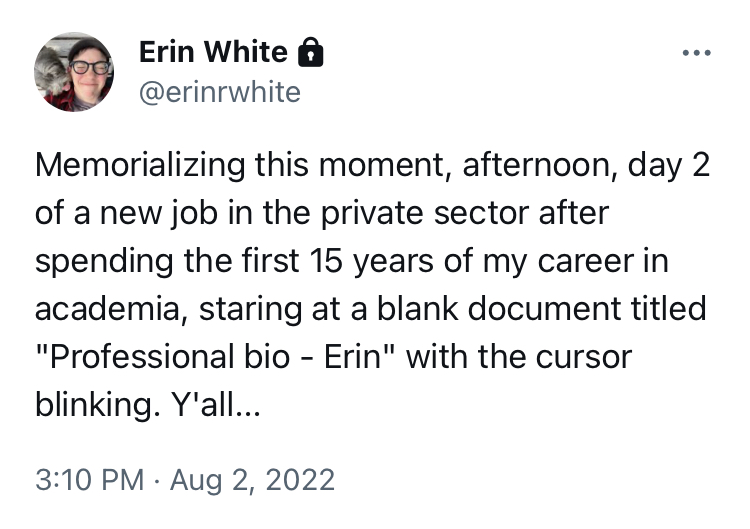
Skip forward to the move. My wife and I were navigating big changes together: new part of the country, new city, new home, new jobs. Along with all of these big changes came some seismic identity shifts for me as I stepped into a new workplace.
For years prior, I told myself I had a distinct identity separate from my career in libraries, and to some degree, I did. But my professional identity crisis after leaving higher ed was still intense and painful.
Finding legibility
Academic librarianship was such a tidy professional identity for me. I’d established myself in my field, was a respected leader at my institution, and was confident in my work. My wife was an academic, too. Many of our friends worked at the university where we worked. All of it fit so neatly together before. Now that I wasn’t in libraries or in higher ed, what was I?
Changing career fields, I struggled to find a new way to relate to my professional identity and tell my story in a way that was legible not only to others, but to me.
This took a long time and is still a work in progress. But it was a potent and necessary reminder that I needed to embrace that I am a person who exists outside of the work I do.
Releasing the expectations
Despite the professional identity crisis, I also felt a deep sense of relief when I was able to release the expectations I didn’t even know I was holding for myself.
I stopped worrying (or even thinking) about many of the things I had found extremely important when I was working in libraries. I felt guilty, but when I could viscerally sense the tension releasing in my body, the guilt turned to relief. I exhaled. I imagine this is what it’s like for many people when they retire.
New to the job, but not new to work
Starting a new job in an entirely new field after 13 years at the same employer was scary. I wasn’t entirely sure I had the experience to do the job well, and was worried that I was stuck in my ways. By the end of the first week, though, I saw obvious areas where I could plug in and realized I brought lots of skills along with me.
Transferable skills
Many folks who have left libraries and higher ed have talked about transferable skills. Some, in particular, that I carried with me into the private sector:
Talking with people and building relationships
Managing projects and stakeholders
Recruiting, hiring, retaining, rewarding, and managing people
Facilitating meetings and workshops, and presenting to groups of all sizes
Writing for different audiences, including communicating “professionally”
Mapping out, clarifying, and streamlining workflows
Strategic planning
Understanding how technologies connect and how the internet works
Putting theory into practice for diversity, equity, inclusion and accessibility
Instructional design, web design, writing for the web, working with legacy processes and systems, data analysis, research, and so much more.
Same shit, different context
The biggest transferable skill I brought with me, though, was perspective.
I spent the first part of my career learning how to navigate ambiguity, see the forest as well as the trees, build relationships, and create good work I was proud of. Entering new workspaces, I realized I’d learned how to read patterns, relationships, power structures, issues and assets in a much different way, and to identify what was going on at an organizational level. No matter where I went, I had the maturity and x-ray vision of someone who’d seen things. I also had a much stronger sense of where I wanted my boundaries to be, and I stuck to ’em.
Knowing myself
After well over a decade of working full time, I also felt at ease about who I was, what I did and didn’t bring, and where I needed to grow. I wasn’t afraid to say “I don’t know.” Though I was apprehensive about starting something new, I was less self-conscious than I was when I first entered the professional world. I very much owned my mid-career status, rather than feeling like a total newbie.
And because all my coworkers were new to me, not folks I had worked with since I was 24, they didn’t see me as a newbie, either.
Beginner’s brain
My new company’s culture was extremely welcoming for newcomers, and I felt supported to be completely honest about how this was a big transition and a learning curve for me.
Rather than seeing me just as someone who needed to be brought up to speed, my new coworkers saw my newness as a value-add. They asked what I thought as someone with fresh eyes on the business, and we ended up implementing several changes early on based on my ideas.
It also felt refreshing to be very new at something, to feel that uncertainty again for the first time in a while, and to remind myself that this was something I was capable of handling.
I also relished learning about how businesses work, which would help me later on when (much to my own surprise) I started my own business. I felt new synapses firing.
The second quarter of my career
Early on at my new job, a coworker explained her move to our company as “the way I wanted to spend the last quarter of my career.” My coworker had carefully chosen where she wanted to spend her last few years in the workforce. She wasn’t putting pressure on herself to follow a certain career progression.
Thinking of work-life as a series of strategic moves, rather than a graph going forever up, resonated with me. Thanks to my new colleague I had words for what was happening. I was starting the second quarter of my career.
A final note on leaving academia
> Anyway, all I ever meant by “the institution cannot love you” was this: whether the institution makes you feel great or horrible, it isn’t about you. Institutions aren’t choosing NOT to love you. They are choosing to reproduce themselves.
>
> Tressie McMillan Cottom
Many smart folks have written about leaving academia. Academic and cultural heritage institutions anywhere are going to do one thing for certain: self-perpetuate at all costs. “Institutions gonna institution” is a common refrain at our house.
The more I moved into leadership positions at my previous institution, the pricklier I felt about maxims like “the institution cannot love you”, because it felt personal. But it’s not personal. Academic and cultural heritage institutions thrive when employees believe these falsehoods:
You’ll need an outside offer if you dare to ask for a raise.
If you just follow the right administrative process, justice will be served.
The institution cares about you and will protect you.
My wife’s situation brought a lot of this into sharp focus for me. I realized that, especially as a middle manager, I had believed and perpetuated many of these myths for years. Leaving academia helped me see this all more clearly and learn what’s important for me.
My departure from academia made space for my wife to heal, too. Though she’s still in higher ed, her workplace is unionized, and she has far more protections than before. And because I’ve got a foot planted firmly outside of academia, we are both a little more more grounded, hopeful and happy.
This story is to be continued. Maybe there’ll be another update in 2032. Stay tuned.
Resources
For folks sticking around to fight the good fight in higher ed: the United Campus Workers Union continues to grow its power.
I’ve started, and continue to update, a guide to getting a job outside of academia, in part because so many folks have reached out for advice. Perhaps you’ll find it useful too.
Some related posts from former cultural heritage workers that have helped me a lot:
]]>erinrwhiteJob hunting in tech – spring 20232023-07-14T21:55:16+00:002023-07-14T21:55:16+00:00https://erinrwhite.com/job-hunting-2023This spring I went on the job market in hopes of moving back into a tech role. After 96 days of searching, 79 job applications, 20-something interview sessions at 11 companies, I got an offer for a new job this June. Hooray! Also, oof.
Job hunting, simply put, sucks. Please do not let the LinkedIn influencers tell you a new job can be willed into being if you’re just passionate enough. It’s a numbers game, a crapshoot, and a deeply demoralizing mindfuck. I’m a pretty confident person and this process had me down in the dumps. I’m sharing this info in hopes that it’s helpful for others and as a record for myself when I’m on the market again.
Big themes
Some big things that I observed:
Jobs are more plentiful in the private/tech sector and there are also more applicants, especially for fully remote jobs. Folks are hiring on a different scale. And many companies treat applicants accordingly. 🚮
Timelines are wacky as hell. In higher ed, it can be 4 months at best between a vacancy and a hire (and for tenure-track roles, Jesus take the wheel). The private sector moves faster…mostly. I heard back from some jobs within a day or two. Others took a few weeks. Some, I never heard back from.
Rejections are helpful and rare. I heard back with a yes or no from only half of the jobs I applied for. 👻
Interview processes take weeks. Every place where I got to the interview stage let me know I’d be doing at least four different video calls – on different days, different weeks – to complete the interview process. This was a disjointed process and never a positive experience for me.
Nobody shares interview questions in advance. The really kind and inclusive practice of sharing questions in advance of an interview is becoming more common in higher ed/libraries and is just hilariously nonexistent outside of those spaces. I take that back. One of the interview session leaders at one place I interviewed sent questions in advance. I was so grateful. That was the best interview session of my entire job search.
People want to help. With few exceptions, most folks in my network were eager to help and extremely supportive. I got better at asking for, and accepting, help. Also, shoutout to my wife for her unwavering support during this time!
My resume isn’t special. I mean, we are all special, and I stopped being so precious about my resume and asked multiple friends to help me revise it, find ways to talk about my experience, and angle myself appropriately for new roles. Separating my self-worth from my work has been a whole journey since leaving higher ed. Hopefully getting 38 rejection emails has helped move me along the continuum a little bit.
Money hits way different. The first time I was asked, “What are your salary requirements?” I ’bout fell out of my chair. The salaries are higher in tech than in higher ed and certainly in libraries. I have sold out. This is fine.
What seemed to work for me
Learning the language. I had never worked in the private sector before 2022. Things are just worded differently and have different names in business, so learning some of that language was helpful. I think that’s an entirely different post and I hope I get it together!
Updating my LinkedIn After 13 years in academia I hadn’t really thought much about my profile. LinkedIn is a whole-ass weird ecosystem especially for folks in the private sector. I found some folks who I thought had good/aspirational profiles and updated mine with more details, using language similar to theirs.
Working my network. I reached out to friends, previous colleagues and acquaintances for advice, resume reviews, and internal referrals at their companies. Most folks were very eager to help.
Asking for informational interviews with folks who had roles similar to the ones I wanted, or who worked at companies that interested me. I tried to keep these to a half hour to respect folks’ time. These conversations helped me (1) get better language to describe my own skills and what I wanted to do; and (2) make connections with folks who could refer me for open positions later on.
Finding companies I wanted to work for and setting up job alerts for them.
Updating my resume for each job application. I copy/pasted lines/phrases from the job descriptions or required qualifications into my resume then made small changes.
Keeping track. I made a spreadsheet of jobs I applied for. Title, company, link to job ad, salary range, date applied, status (applied/no response, rejected, interviewed, etc.) and any other notes I wanted to add.
Approaching each interview as a conversation. After being on the other side of the hiring table for a very long time, I felt more confident about myself, what I brought to the table, and the types of organizations I wanted to join. I asked questions, followed up my own answers with questions, and generally tried to understand the motivation behind each question that was asked. If someone was looking for a “bias towards action” what would that mean day-to-day? I also asked about their DEI goals and challenges which was a good litmus test for how committed companies were to tackling that work.
Letting myself feel the feels. Truly, it is hard out there, and though it’s easy to tell myself that it wasn’t about me, I often felt stressed, sad and hopeless. When I needed to I would give myself a day or two off from applying so I could rest. And I would also remind myself that I was still glad to be out of academia.
Where I looked
Websites for companies I was interested in for remote work and companies nearby with hybrid roles that I thought would be a match for. I signed up for so many email alerts.
LinkedIn A necessity. Lots of jobs here, searchable on many facets. Can set up push notifications and email alerts. Highly recommend.
Indeed Many jobs here that aren’t on LinkedIn – including local jobs, hourly, contract and term-limited jobs.
People-first Jobs Focuses specifically on organizations that (at least claim to) put supporting their people at the top of their priority list.
Words of Mouth an extremely useful newsletter for hearing about work/fellowships/opportunities from mission-driven companies. This is especially for folks from a humanities/writing/design background.
Tech Jobs for Good nonprofit jobs in tech – not a super high volume but worth a subscribe.
Public Sector Job Board Rebecca Heywood compiles an excellent weekly list of government IT/tech jobs.
We Work Remotely more startup-y; interesting feed of remote work oppportunities
Otta specifically for jobs in tech/startups. Can be personalized based on what type of company or role you’re interested in.
Finally, I must give a huge shoutout to the amazing folks in the GLAMed Out discord community for providing support, resume review, job leads, commiseration and shared joy. If you’re thinking about leaving your work in GLAM to seek techy jobs in other sectors, reach out! I’d love to support folks going down a similar path.
]]>erinrwhiteA bit of an update2023-01-20T22:00:42+00:002023-01-20T22:00:42+00:00https://erinrwhite.com/a-bit-of-an-updateIt’s been a whirlwind year in our household. My wife got a job as an associate professor at RISD, so we both put in our notice at VCU, picked up sticks and moved our household to Providence, RI. I’ve moved out of libraries and academia (for the most part…) and am working at a Richmond-based diversity, equity and inclusion consultancy. I still moonlight each fall as an adjunct instructor of Information Architecture at UTK. We miss our beloved community in Richmond and at VCU, but have been enjoying new things in Providence.
After 13 years in Richmond and at VCU, I didn’t see myself moving – let alone leaving the South! – but it has been invigorating and restorative to make this change. We can do hard things.
 A cortado at Borealis in Riverside.
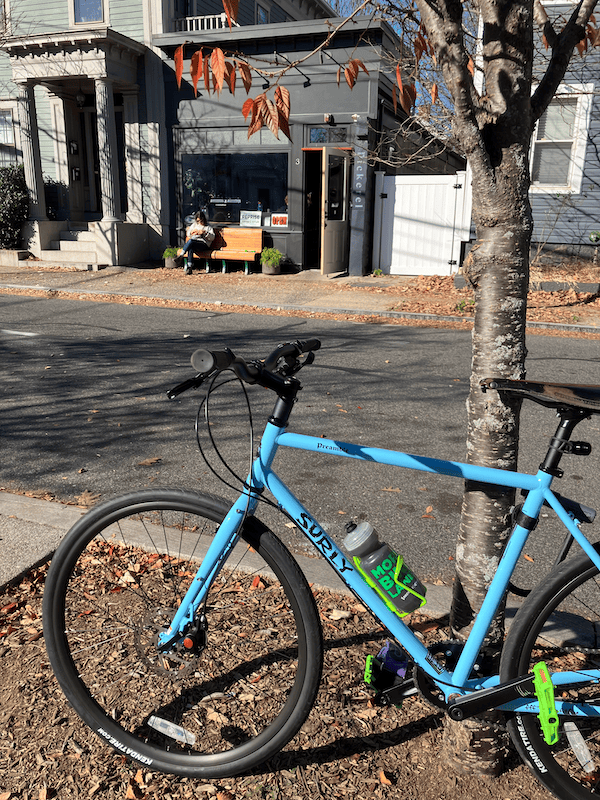 Lil’ City Ripper.
 Progress on the Woony bike path.
 It’s been a whirlwind year in our household. My wife got a job as an associate professor at RISD, so we both put in our notice at VCU, picked up sticks and moved our household to Providence, RI. I’ve moved out of libraries and academia (for the most part…) and am working at a Richmond-based diversity, equity and inclusion consultancy. I still moonlight each fall as an adjunct instructor of Information Architecture at UTK. We miss our beloved community in Richmond and at VCU, but have been enjoying new things in Providence.